Why I Quit Golf, and Why I Came Back
I quit.
Not today. Years ago.
I walked away from golf. Then I moved to Australia.
I didn’t touch a club for over two years.
A couple of casual games with rented clubs. Inside, I was done.
I started at eleven. I went to my Dad’s golf course to earn pocket money helping in his shop, and I just got interested in golf.
My Dad was a pro himself, but he never pushed me into golf. In some ways I wish he had. Maybe if I’d started earlier, I’d have been better. What I realise now is that him not pushing me is the reason I fell in love with the game. You can’t force someone to love golf. The game chooses you.
As a kid I was more into football, then basketball, then skateboarding. The problem was that I kept injuring my wrists skateboarding, which meant I couldn’t play golf at the weekends. So I gave up skateboarding at around twelve.
I spent the next decade trying to get better. Practising every day after school. Hand on heart, I can say: nobody I knew practised harder than me.
And I could play. At 16 I shot 69 on the medal course at Monifieth, two under par. It was the first time I’d broken par on a proper golf course, and in a competition.
I lost the final of the Monifieth Links one year to Mark, my closest rival. The next year I beat him. I was two under and playing as well as I ever had. He made twelve pars in a row and was still two down.
At 18 I had a decision to make: a golf scholarship in America, or Stirling University. I chose Stirling.
Uni didn’t go as planned. I was turned down for the university’s scholarship programme, and back then the university golf club was run by scholars, for scholars. I played next to no competitive golf in my first year. It was an incredibly frustrating time.
Then I got a meeting with Raleigh Gowrie, who ran the university’s elite golf programme. That meeting ended with me running the golf club, and in my third year I was its president.
In that meeting Raleigh said something that has stuck with me ever since: “You’re either pregnant or you’re not.”
It gave me an all-or-nothing mentality. In some ways that’s a good thing, but not in every area of your life. All or nothing with dieting, for example, just means punishing yourself for not being perfect.
Through university, my swing got better. My scores didn’t.
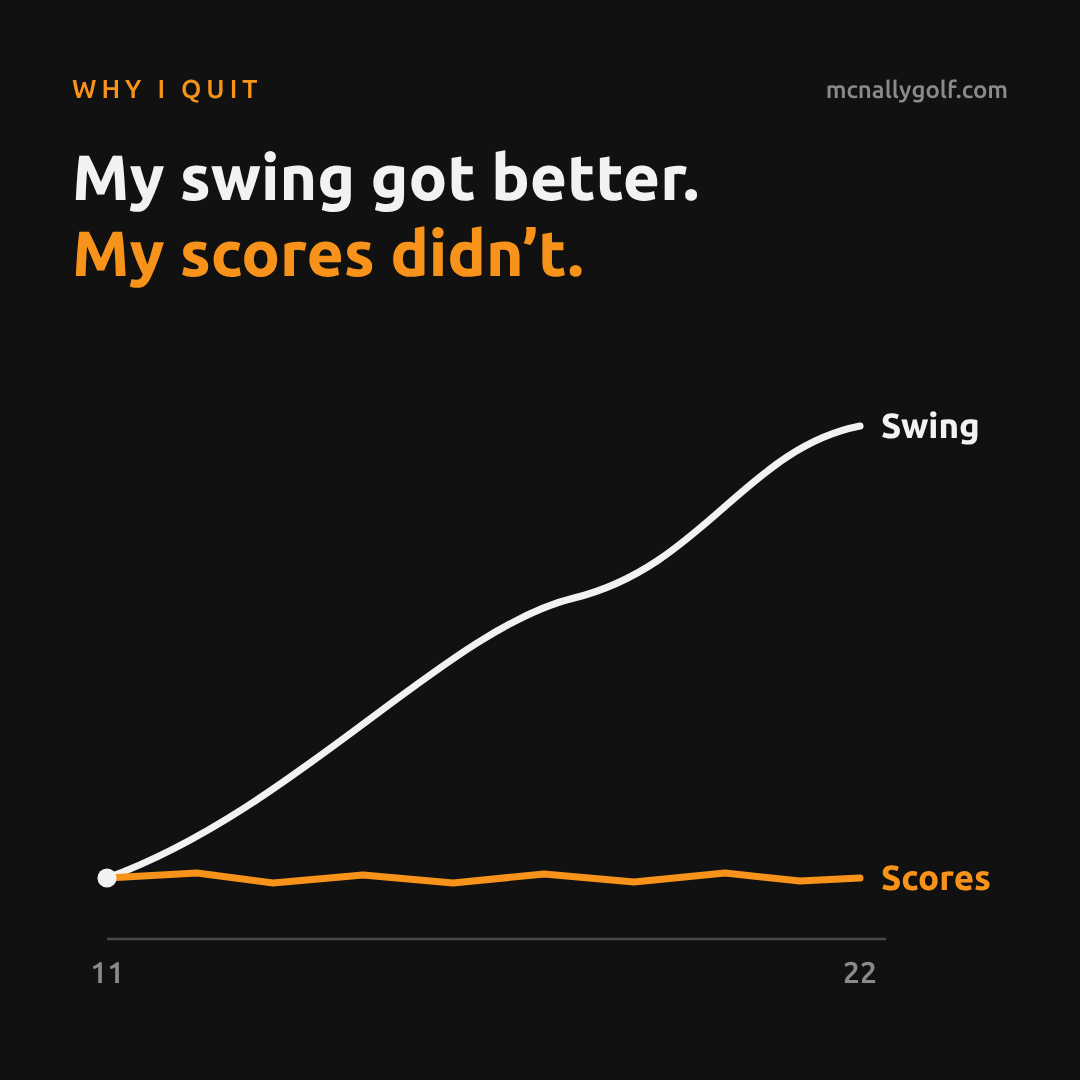
By 22, despite all that hard work, it was clear I was nowhere near the level of the scholarship players, and my dream of competing for the best prizes in golf was looking unlikely. University was over, and it was time to enter the real world.
I moved back to Newcastle to live with my parents. I felt like a failure. Like I wasn’t good enough.
But the truth? I hadn’t failed. I’d quit.
That voice in my head, “you’re not good enough”, has followed me my whole life. It still does, sometimes.
The hardest part to admit? I had every advantage. My Dad was a golf pro, and I had access to coaching most golfers could only dream of. Yet I still couldn’t make it work. Deep down, I’d convinced myself I just wasn’t good enough.
My Dad did the best he could with what he had, and I’m grateful for everything he gave me. But back then, we didn’t have what I know now. No systems. No structure. No tech. No real understanding of how to turn practice into performance on the course.
I spent ten years chasing the perfect swing. I realise now that was a mistake. I wasn’t playing golf. I was playing golf swing. And that’s what kept me from the potential I had. At the time, I didn’t know what skills I needed, or how to build them.
I had no idea what to do with my life when my best friend, who later became my best man, phoned me. Did I want to move to Australia with him?
Why, I asked.
“We can either get rubbish jobs here, where the weather’s grim, or rubbish jobs in Australia, where the weather’s class and the pay’s better.”
I couldn’t argue with his logic. With no better offers or ideas on the table, I thought, why not, let’s do it. And off we went.
I had some great experiences in Australia, and if I could, I’d have stayed. But it was a long way from home. I missed my family, golf and Newcastle United.
When I came home, I’d spent every penny I had on travelling. I was back living with my parents in Newcastle. No plan. No clue what to do next.
While I was travelling I found a blog by Joel Runyon. Joel had written a list of everything he wanted to achieve, things he thought were impossible at the time, and called it his Impossible List. So I wrote my own and started documenting it on a blog, to keep me accountable, and maybe inspire someone else to do the same.
Back home, I turned it into a podcast, before podcasts went mainstream. It never made me a penny. It was a passion project, and I needed some kind of job to keep it going.
I couldn’t imagine getting a normal job. That’s when it hit me: golf is all I’ve ever known. It was the only thing I’d ever known I was good at.
So I used the sales and marketing skills I’d picked up in Australia to help my Dad with his coaching business at Sunderland Golf Centre, Wearside Golf Club and Ramside Hall. We took over the pro shop at Wearside, and I found myself managing it.
Things were going well, but I was still looking for something more. I started looking for golf jobs, saw an advert for a job at Murrayfield, applied, and got it.
I left Newcastle, moved to Edinburgh, and worked about 30 hours a week in the shop. In some ways it felt like a step backwards. But getting away from Newcastle was a step forward for my own independence.
I was getting by. But I wanted more than minimum wage selling Mars bars.
And I could see the demand for coaching at Murrayfield. I thought to myself: I could do this.
So I stopped the podcast to chase the dream I’d walked away from: turning pro.
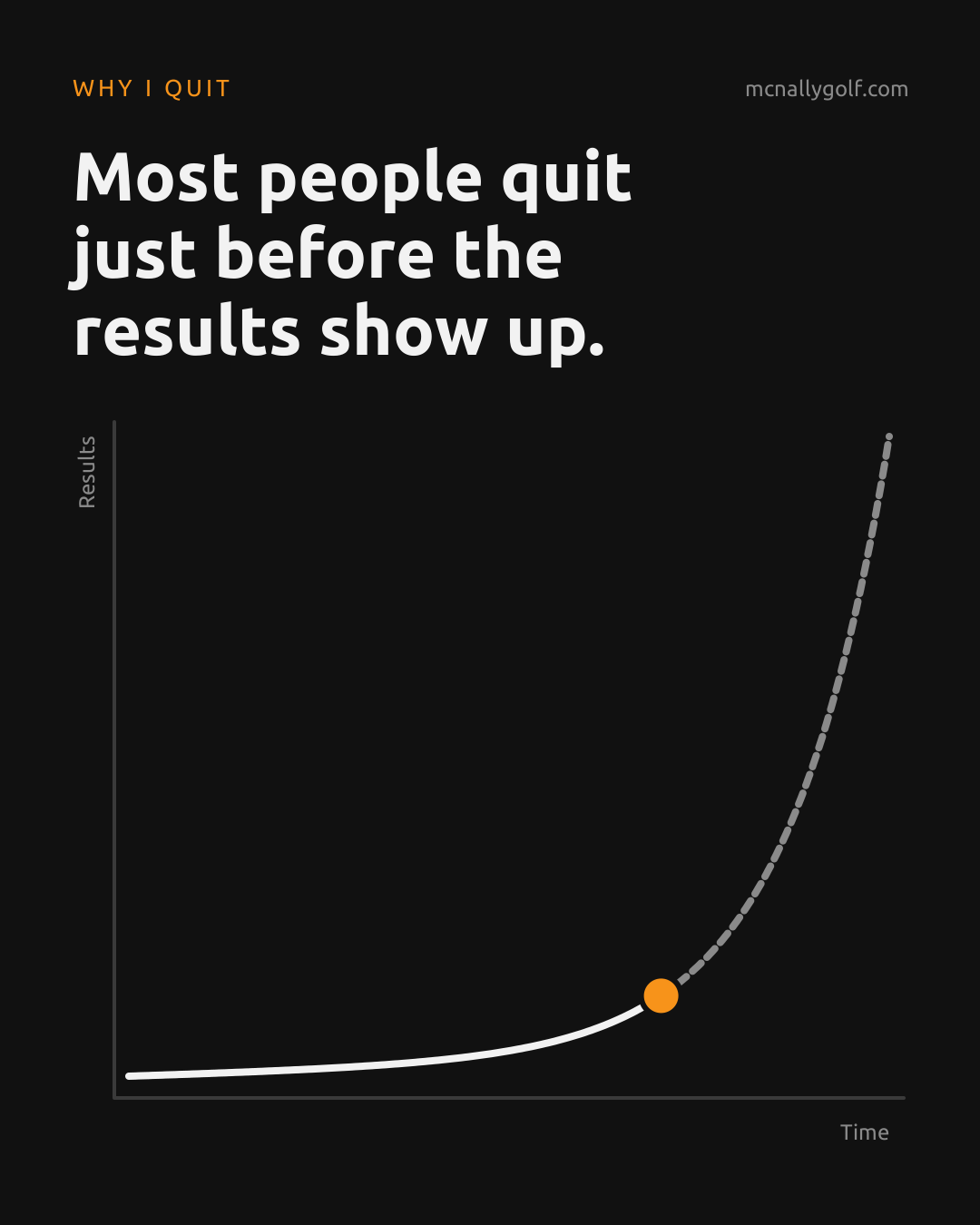
Looking back, if I’d kept the podcast going, it might have grown into something. I’ll never know. What I do know is that most people quit just before the results show up.
I set myself a challenge: get my handicap down to 5 so I could start my PGA training, pass the PGA playability test, and turn pro.
The problem was, my handicap had lapsed. When I handed in my first three cards that summer, it came out at 9. By the end of the summer I was off 4.
I failed the playability test the first time. I didn’t give up. I went back, and I passed.
I turned pro. But I didn’t turn pro to play. I turned pro to coach. To help people who feel the way I once did: like they’ll never be good enough.
I found the missing piece years later. After covid, I left Murrayfield to join Peter Arnott at Swanston so I could coach full time.
Spending time with Peter made me realise how set in my ways I’d been with my swing, and how unwilling I’d been to adapt. How much the environment around a golfer matters. And that a better swing doesn’t mean better golf. It’s why my swing got better and my scores didn’t.
It slowly and then suddenly hit me that I was good enough. I just didn’t have the support or the tools for the challenges I’d have to get through on the way.
I don’t want another golfer to give up for the same reason I did.
That’s the work I want to do: help golfers who’ve started to believe they’re the problem find out what they’re actually capable of, and give them the support and plan to get there.
Walking away isn’t always the end of the story. Sometimes it’s what you need to find your way back.
The Sunday List is one idea a week, never a tip. Join here.
If you’re in Edinburgh, book an Assessment.