“Golf Lessons Don’t Work for Me”
You book a lesson. You’ve been fighting the same miss for weeks, you’ve tried to fix it yourself, and you’ve finally decided to ask someone who knows.
For an hour, it works. The coach changes something, the ball starts doing what you’ve wanted it to do, and by the end you’re hitting shots you didn’t think you had. You drive home thinking you’ve cracked it.
Saturday comes round. You’ve got a game with your mates, and you can’t wait to show them.
First tee. You make the new swing. The ball goes nowhere near where it went on the range.
Fine. One shot. You try it again on the 2nd. Same result.
On the 3rd tee you give it one last go, and the ball goes off the planet.
By now you’re losing, and your mates have noticed. That lesson was money well spent. Maybe book a few more. Everyone laughs. You laugh too, but you feel like an idiot.
So on the 4th tee you go back to what you know. The old swing. The one that got you here.
You lose the match, and if you’re honest, it was over on the 4th tee. The strange part is the back nine. You play better. Nothing special, just better, because you’ve stopped thinking about the lesson.
On the drive home you reach a conclusion: golf lessons don’t work for me.
You don’t go back to that coach. You carry on alone for a while, until the next slump, when you try someone new.
I’ve played that round
I know that round well, because I’ve played it. More times than I’d like to admit.
I’d come away with something new, take it straight to the course, and judge it on the first few holes. If it didn’t work there, I’d drop it and go back to what I knew. Then I’d wonder why I never seemed to get any better.
I didn’t know when to work on a change and when to forget about it and play golf. I learned that from Peter Arnott, a coach I work alongside at Swanston. Before you play, decide what the round is for. Are you there to explore the change and find out how it holds up away from the range? Or are you there to perform, and get the best score you can with what you’ve got today?
You can practise a change, or you can try to shoot a good score. Trying to do both on the first tee, with your mates watching, is where it gets difficult.
When you’re exploring, a bad shot is information. When you’re performing, it costs you. The golfer in that round was exploring a brand new change and judging it like a medal. It never had a chance.
That’s the gap a single lesson leaves. A change that works in a lesson is not yet an improvement.
Where the lesson stopped
Look at where that change had been tested before Saturday. On a range, with a coach beside you, hitting the same club at the same target, with nothing riding on any shot. Then it went straight to a first tee, a scorecard and an audience.
Wanting to beat your mates is fine. Everyone who plays wants to score. What hurt you was asking a change that was an hour old to hold up under the most pressure you face all week.
Getting a change from the lesson tee to the first tee is part of the coach’s job. If a lesson ends with “go and try that”, the coaching has stopped too early. The seven places below are how I do that.
So one of the first things I ask is whether someone wants a change or an improvement. A change is something new to do. An improvement is a better result that still holds up when it matters. Change for change’s sake is pointless.
Seven places to prove it
For an improvement to stick, you need to show you can do it in seven places, each one harder than the last:
During a lesson, with a coach.
On your own, on a range.
On your own on a range, playing a skills or performance game.
On the course, with the purpose of the round framed as exploring the change.
On the course, with friends watching.
With a scorecard in your hand.
In a competition, where the result is formally recorded.
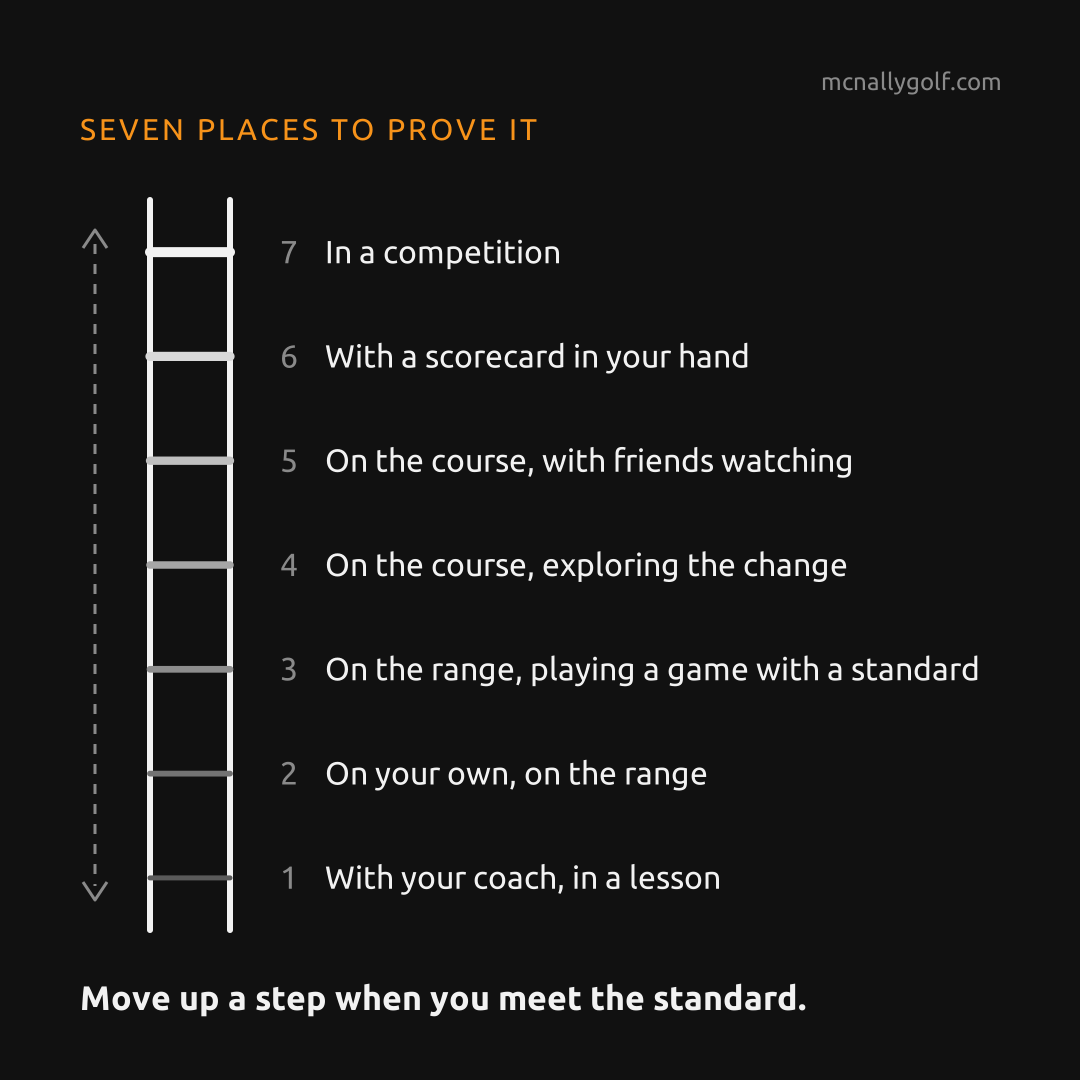
Most golfers move up and down it. Some steps take a session. Some take weeks.
Moving up a step means meeting a standard we agree together, so we both know what success looks like.
Say you’re losing too many balls off the tee. We might pick a target on the range about as wide as a fairway (four fingers held out at arm’s length covers roughly that) and set a standard of six balls out of ten inside it. Pass on the range, and the same game goes onto the course.
We set the standard to suit the golfer. It needs to be hard enough to mean something, without making success unrealistic.
When it goes wrong
Sometimes you’ll move up a step before you’re ready. That’s useful too. It shows exactly what needs more work.
Playing with friends watching can be where it starts to fall apart. When it does, we go again. The conversation afterwards usually sounds the same: they were worried about how the shot would turn out, and about what their playing partners would think.
Nobody’s watching as closely as you think. They’re worried about their own game. What you can control is your routine and the job of the shot in front of you. A good shot at that stage is one where you stayed committed to the process, whatever the ball did.
Then tell your coach where it fell apart. If your coach doesn’t know you’re struggling, they can’t help you.
Learn or perform?
Peter spends most of his time researching how practice carries onto the course. This is the question at the centre of it, and the one to ask before you hit a ball, on the range or on the first tee:
Am I here to learn, or to perform?
One idea a week, never a tip. The Sunday List: mcnallygolf.com/sunday-list
If you’re in Edinburgh, book an Assessment.
The Sunday List
One idea a week, explained properly. Never a tip.