The Round That Taught Me Nothing
In Why I Quit Golf, I mentioned the 69 I shot at Monifieth when I was 16. The first time I'd broken par on a proper golf course, and in a competition.
I want to tell you that round taught me something. It didn't. It taught me the wrong lesson, and it cost me years.
What I thought it proved
My Dad was a brilliant technical coach. He'd trained in Stack and Tilt and the MORAD system, and he'd spent time with Mac O'Grady, whose teaching popularised the positions golfers now call P1 to P10.
So my golf went like this. I'd play, then go to my Dad and say, "Can I have a golf lesson, Dad? I'm struggling with this."
He always gave the same reply. "Sorry Mike, I don't do golf lessons. But if you want some coaching, let me know."
Almost every day after school, my Mum would drop me off at the practice ground, and my Dad would meet me there after he'd finished work with his high-speed video camera. He'd film a few shots face on and down the line, and we'd pick one of the ten positions to improve. Then it was practice swings and freezers: stop at the top of the backswing, hold it for a few seconds to try and feel and perfect the position, and then give it a hit.
To most people it would have looked repetitive and boring, and I'd agree. It was robotic. But I thought it was making me better, and I was obsessed with the idea of getting better. I loved it. That's why I kept doing it.
Then came the 69. In my head that settled it. Whatever I'd been doing, it was working. The proof was on the card.
So I did more of it. More time with Dad. More lessons. More practice swings, more reps, more balls on the range, more hours. I'd read about the 10,000-hour rule, and I wanted to train like Tiger Woods: show up every day and never take a day off.
What actually happened
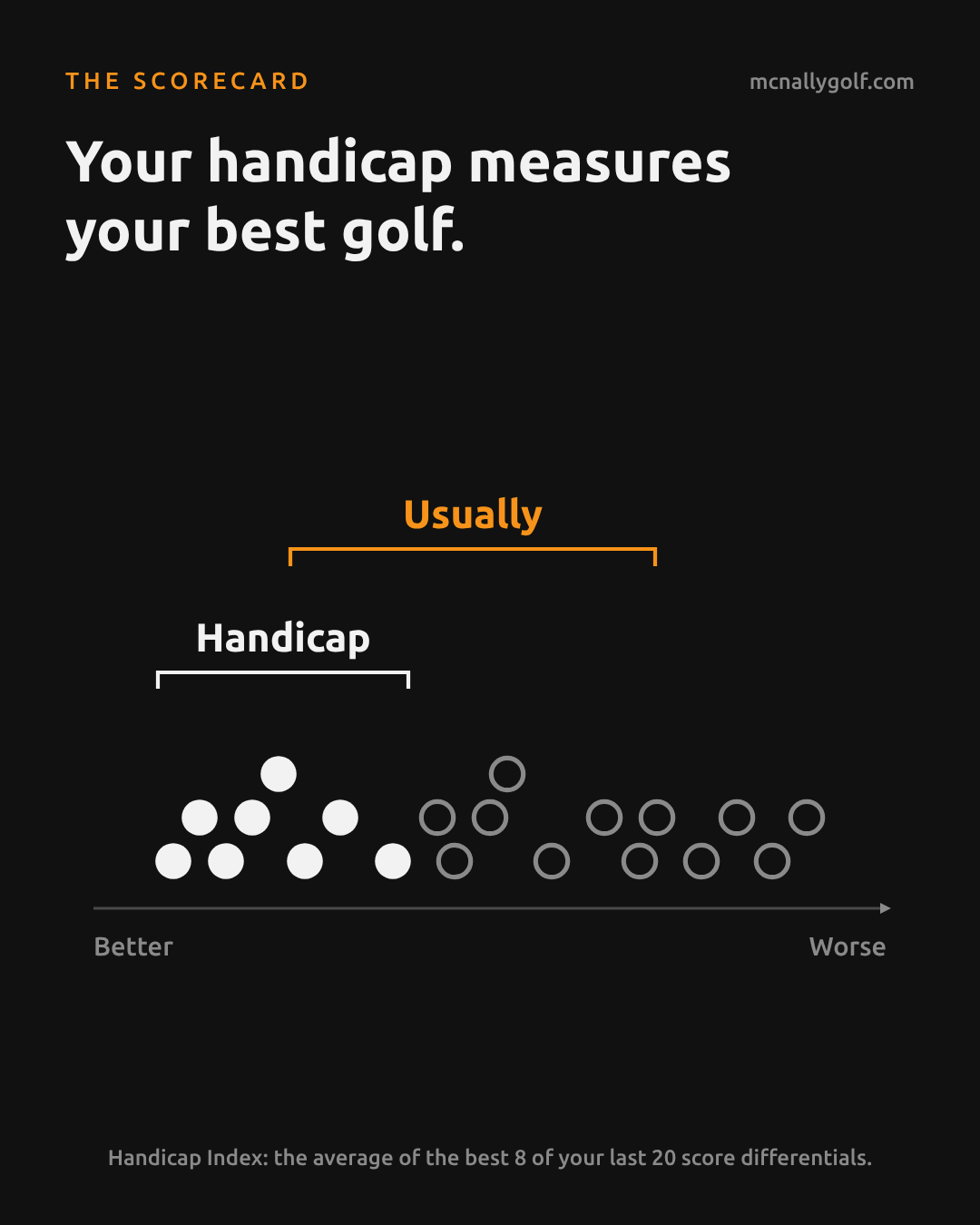
A low round means that on one day, more things lined up than they usually do. Your timing held, your strike was good, the putts dropped and you got some kind bounces. Sometimes you just get lucky. That can happen in the middle of doing all the wrong things.
After the 69, my scores went back to the mid 70s on a decent day and the mid 80s on a not so good day. But my handicap had dropped to 3, and members at the club kept congratulating me. That score gave me confidence. Then it gave me pressure. The lower my handicap went, the less room I felt I had for a mistake. One triple bogey and I was over my handicap, so every round became a one-bad-hole round. I'd built my confidence on a number, and numbers move.
My Dad taught me the positions well. What I didn't know then was that I'd never linked any of them to my ball flight. I could freeze at the top and feel it, but I couldn't tell you what it did to the ball. It's part of why all that practice never showed up on the course.
I looked at the card and saw proof. The question I never asked was what had produced it. So I took the confirmation I wanted, carried on, and bought myself years more of guessing.
The same thing works in reverse. A bad round makes you think the thing you're working on is wrong, so you change it. Either way, the score makes the decision instead of the shots.
What a good round can show you
A good round does tell you something: what you're capable of. You can find that out on purpose.
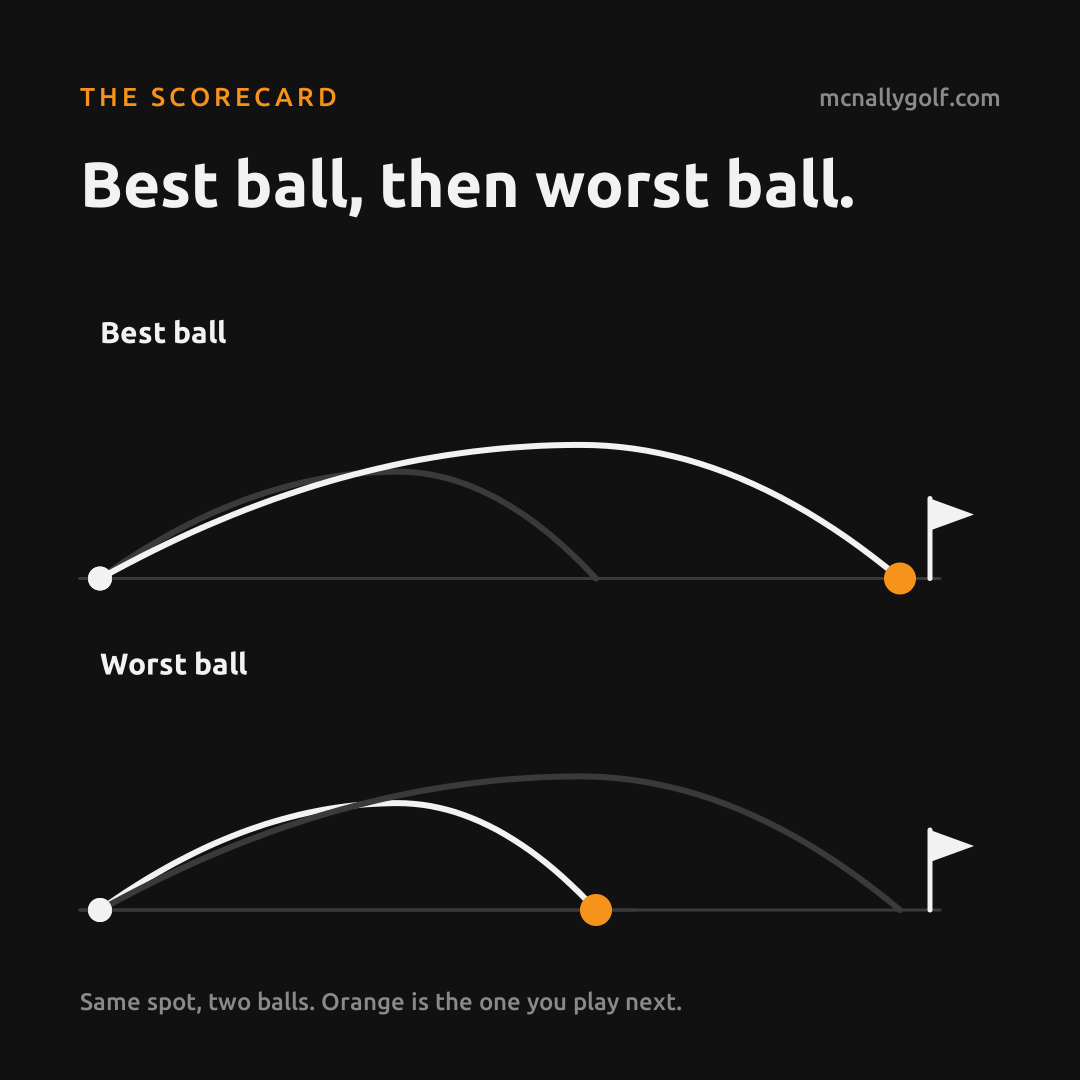
Play a round of best ball on your own. Hit two balls from every spot and always play the next shot from the better one. It shows you what your game can produce when it gets a second chance at every shot.
Then try worst ball: two balls, and always play from the worse one. It's brutal, and the number at the end means little on its own. Watch instead for which shots you can repeat and which only turn up on a good day.
What I'd tell that 16 year old
You played well. It doesn't mean you found the answer. Next time you shoot a good number, don't ask whether the method works. Ask what actually produced the shots, and whether you could do it again on a day when nothing lines up.
It took me a decade to ask that question.
If you’ve had a round like that, one that told you you’d found it, leave a comment and tell me what you think actually produced it. I read every comment.
If you're not in Edinburgh, The Sunday List is one idea a week, never a tip. Join here.