You aim at the flag. The ball drifts a few yards off the edge of the green and into the first cut. Missed green. You walk off annoyed, as if you've hit a bad shot.
Many golfers play as if they're holding a sniper rifle. Whatever shot they hit, they expect the ball to go exactly where they aimed. Anything else is a miss.
That expectation costs you. Every normal shot that misses the target gets read as a swing fault. So you change something that was working, and you're back to guessing. The next round, you're standing over the ball thinking about the change instead of the target.
Many golfers don't know how far their shots spread, even when they're hitting it well. So they beat themselves up over shots that were never as bad as they think.
I found out how wide mine was on TrackMan. In 2022, in a speed training session, I hit about 30 drives. I was swinging out of control. From furthest left to furthest right they spread about 110 yards. A strategy can only plan for your solid strikes, so I took out the worst 10% or so of mishits. What was left was still 55 to 60 yards wide. I'm a PGA Professional, and my driver pattern is wider than most golfers would guess.
The best players in the world are no different. Scott Fawcett, who built DECADE, describes a typical tour player's driver pattern as around 65 to 70 yards from furthest left to furthest right. Tour fairways average about 30 to 32 yards wide. PGA Tour players hit about 59% of fairways. They miss fairways every week, and they don't rebuild their swing because of it.
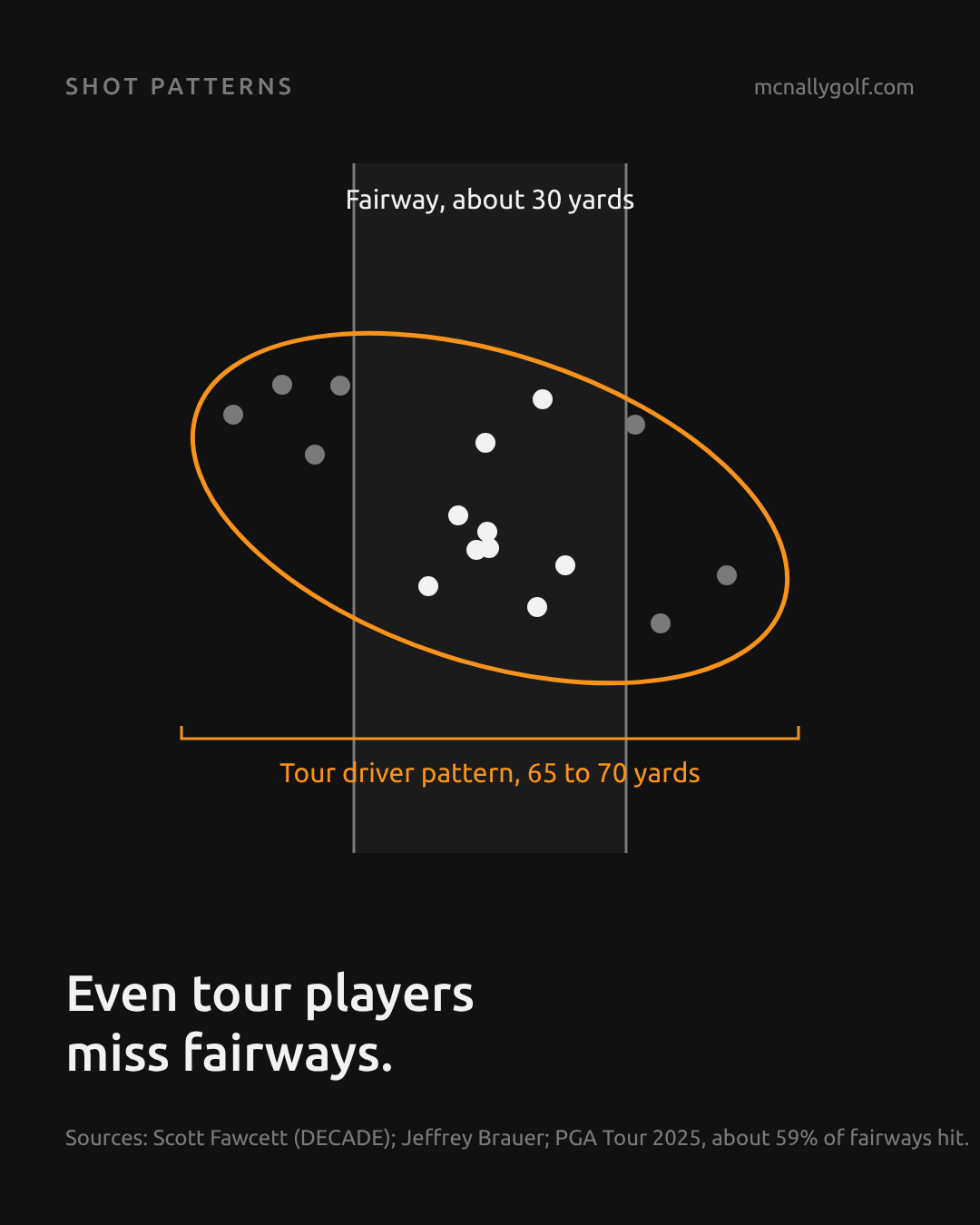
I've learned more about expectations from Scott than from anyone else. His picture is a shotgun. Fire it and the pellets scatter.
The spread of your shots is your shot pattern.
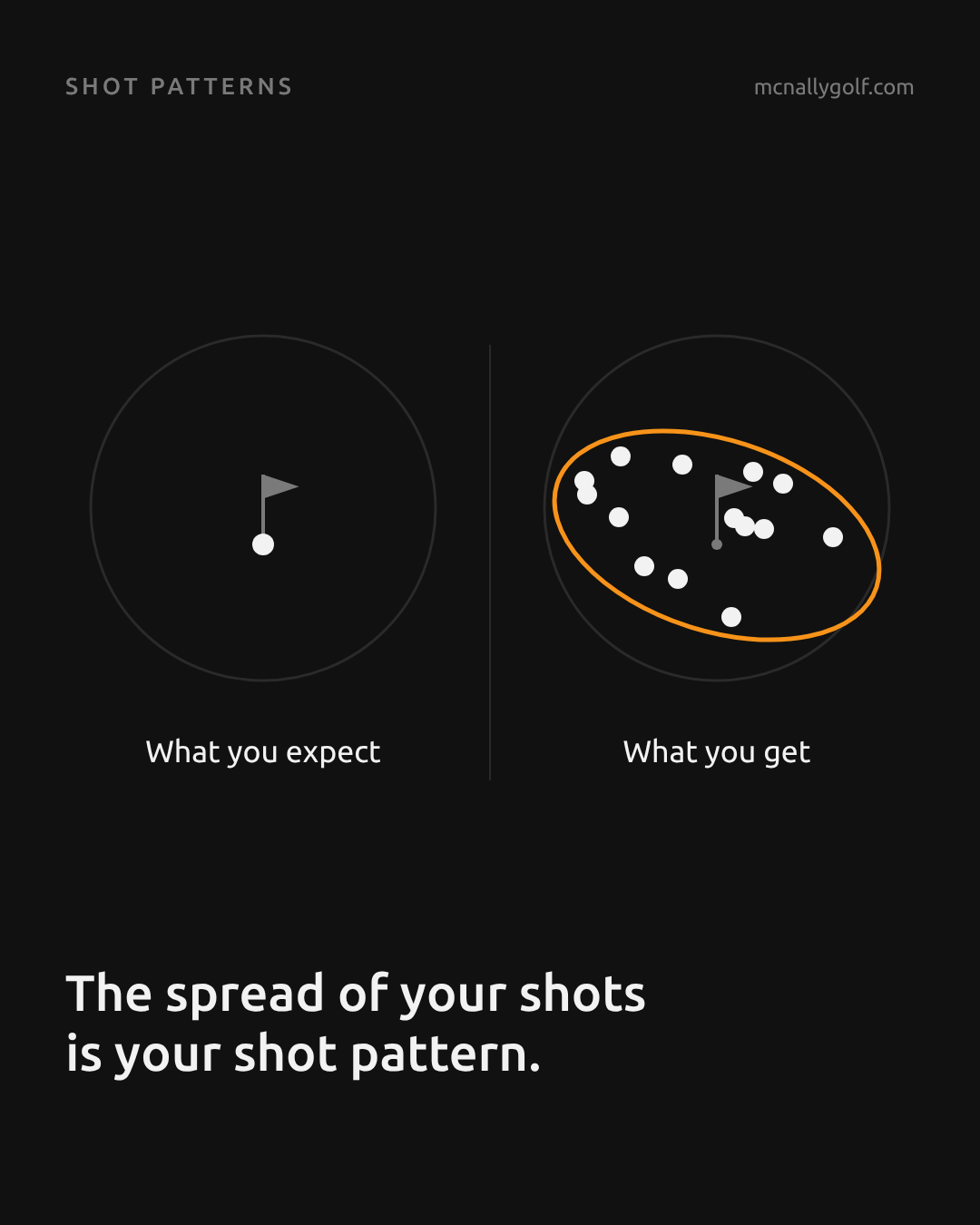
What a shot pattern looks like
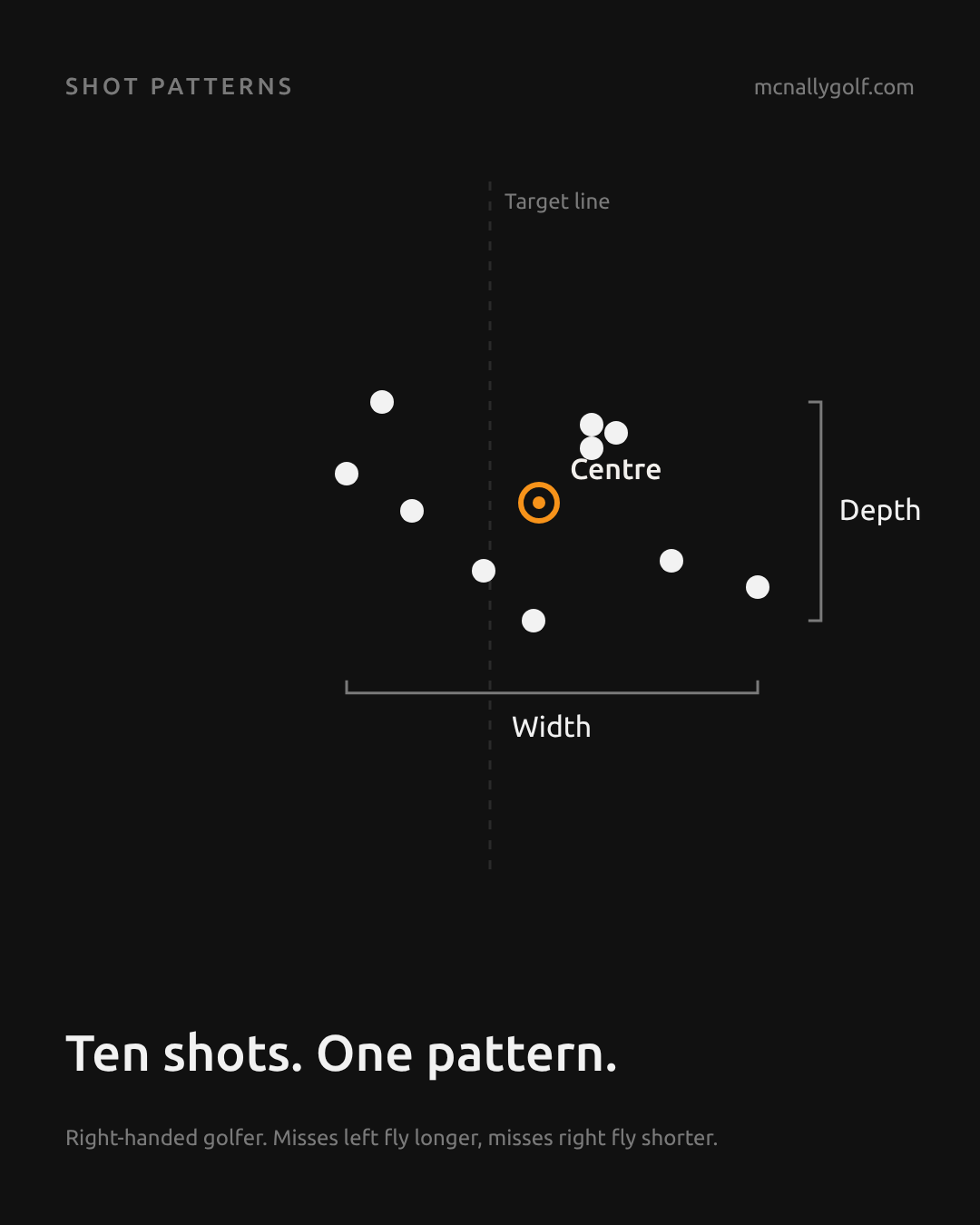
Picture TrackMan's bird's-eye view. Hit ten shots at the same target. One finishes furthest right and one furthest left. The distance between them is the width of your pattern. Measure from the shortest to the longest and you have its depth. For a right-hander, the pattern usually tilts: shots that miss left tend to fly longer, and shots that miss right tend to come up shorter.
Somewhere in the middle of all those balls is the centre of your pattern, what Scott calls the geometric centre. Any single shot is one pellet. The pattern comes with you every time you play.
Play the hole with your pattern
Here's a hole. A par 4, 340 yards. Out of bounds all the way down the left. Trees down the right. A fairway bunker on the left, from 210 to 230 yards. Water down the right of the green.
Many golfers pick a spot in the middle of the fairway and try to hit it there.
Start with your safe shot instead. Every golfer has one: the shot you trust when you need the ball in play. For some it's a little fade, for others a draw, for some a ball that starts straight and stays there.
Still hit driver. Scott has a rule I like: you need a very good reason not to hit driver. Taking less club off the tee doesn't necessarily remove the danger. It just leaves you further back.
Say your safe shot is a fade. Aim 5 yards right of the bunker. Hit it straight and you're still right of the bunker. Fade it as planned and you're middle to right side of the fairway. Overdo it and you might be in the trees.
If you are, take your medicine and chip out. From the trees, the average PGA Tour player makes about a bogey. Bogey is therefore also a good score for everyone else.
You can never take the out of bounds, the shot that costs you two, completely out of play. But you can certainly reduce the odds and move them in your favour.
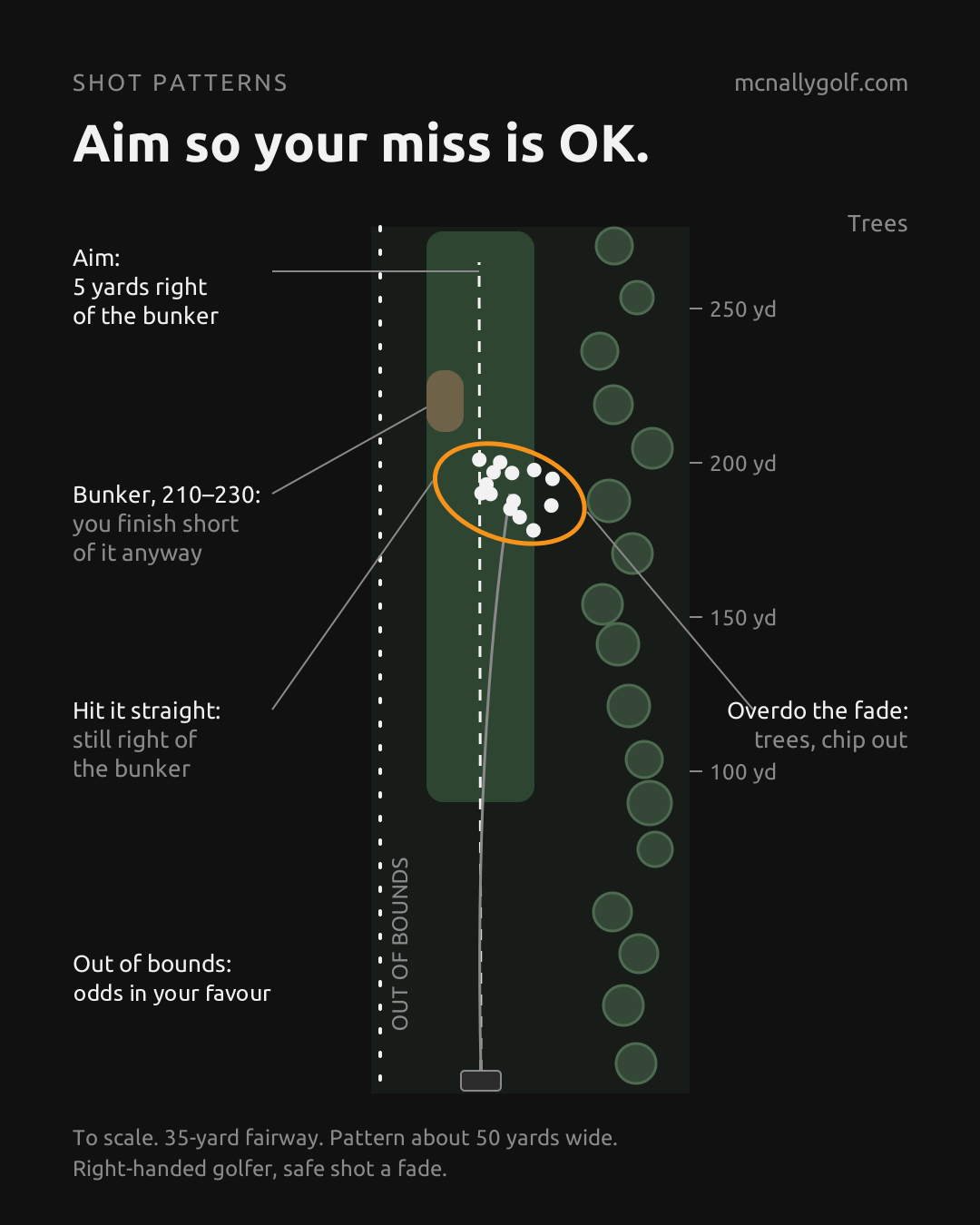
Golf is a game of misses. You'll miss most of the time. The confidence comes from knowing your miss will be OK, because you've picked a smart target and a smart shot shape. Every plan needs an A and a B. What you're avoiding is C, D, E and F.
Birdies happen by accident
Scott has another line I agree with: stop trying to make birdies.
Back to the hole. You've got 150 yards in. Water down the right of the green, the pin on the right side, a bunker short and lots of room long left.
The smart target is long left. That's where the space is, so that's your target. Your intention is to start the ball on the flag with a draw. You club up, so you're always getting over the bunker. You commit to it.
You catch it a touch out of the heel, or leave the face slightly open. The ball doesn't draw. It goes straight at the hole and nearly goes in for eagle.
Your opponent thinks: what a great aggressive shot, I'm going to have to match that. They take dead aim at the flag. The ball curves right and goes splash, into the water.
They tell you that was a great shot. In your head, you know what really happened. You picked a smart target long left. You caught it out of the heel with the face a little open. It was an average shot that finished on the right side of your pattern, and the flag just happened to be where the ball landed. It was your worst struck shot of the day.
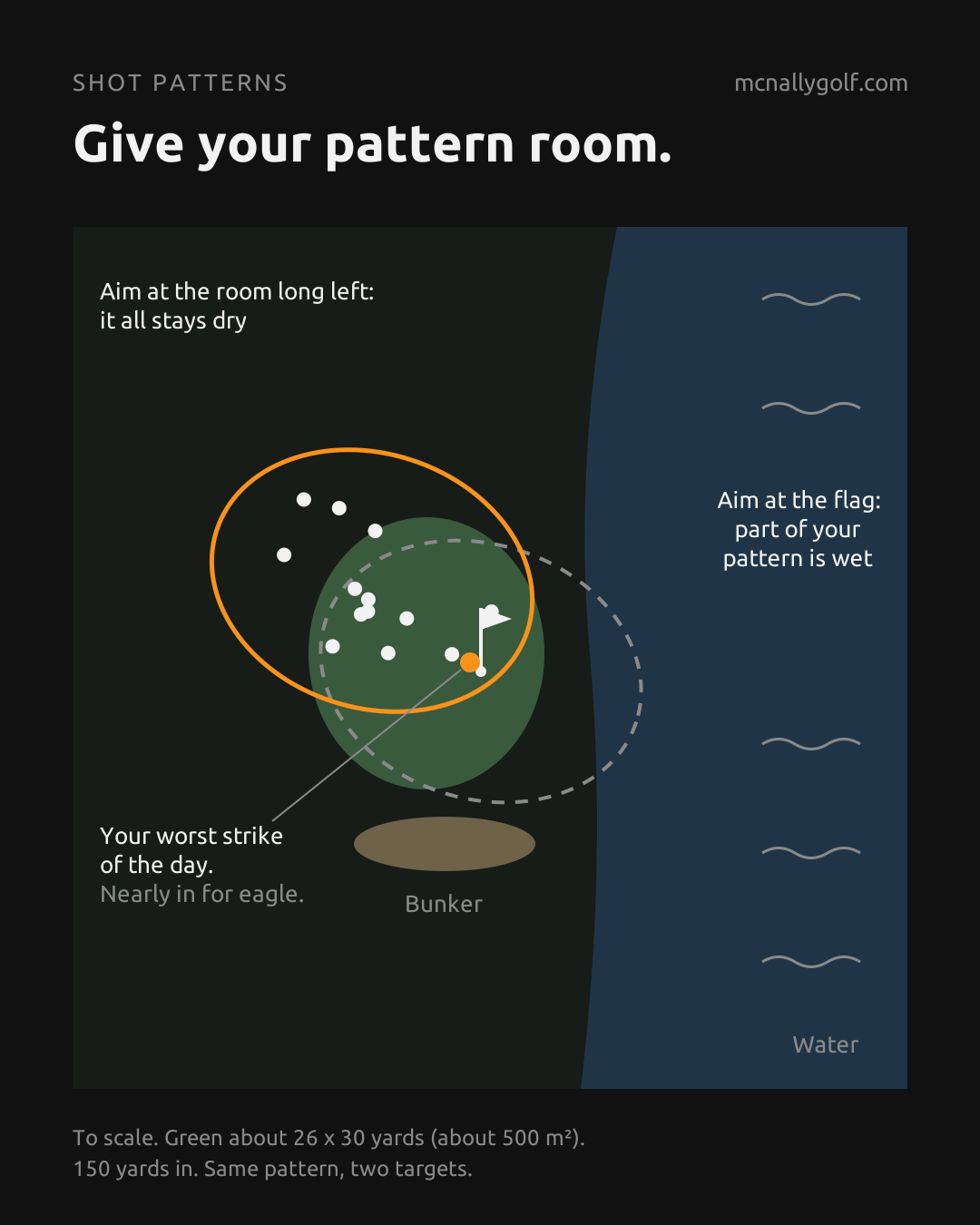
That's an accidental birdie. And that's the mental game of golf. You forced your opponent into a big mistake, all because you chose a smart target.
Scott also introduced me to Mark Broadie's strokes gained work, and the amateur data points the same way. Shot Scope's figures have scratch golfers making about 2.3 birdies a round, and 20-handicappers, who mostly shoot in the 90s, about 0.4. That's roughly two birdies between them, in a gap of close to 20 shots. Avoiding doubles and worse is a big part of the rest.
Your handicap is your best golf
The same thing happens with your score. Your Handicap Index is the average of your best 8 of your last 20 score differentials. It shows what you can do when you play well, so most rounds will come in above it.
If you're off 5, you won't play to 5 every time you tee it up. That's how the system is built. A round a few shots above your handicap is an ordinary round.
Judge the round on something you control
So if the score can't be the only judge, what is?
When I start with a golfer, I ask them what a good round looks like for them. Some say they want to hit every fairway. It's a great goal, but you're setting yourself up for failure from the get-go.
Then I give them a second scorecard. It counts one thing: before each shot, did you pick a smart target by asking where's the space and did you commit to it?
Where the ball finished doesn't change the tick.
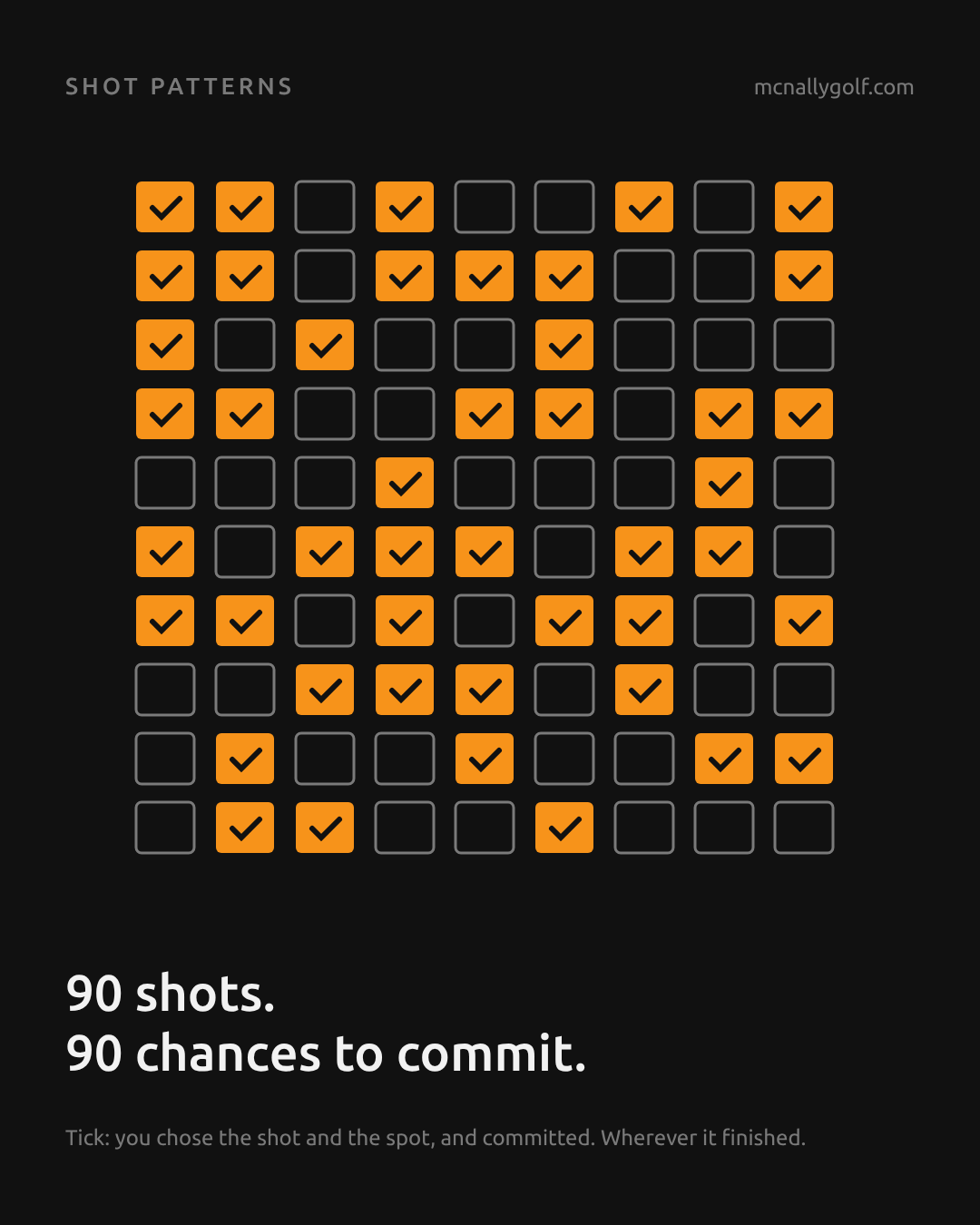
Shoot 90 and that's 90 chances, one for every shot you hit. If you managed it on 45, there's room to double it, and that number is in your hands in a way the score isn't.
Peter Arnott once did a strategy webinar where he gave the example of Leo Messi. In the first few minutes of a football match, Messi would stand and walk about, looking around to try and identify where the space was so he could receive a pass. Pep Guardiola, who coached him at Barcelona, said that after five or ten minutes Messi has a map of the pitch in his eyes and his brain. He's world class.
Tiger Woods gave a great interview that illustrates this. Asked about his aggressive play, he said something like: I play aggressively to my spot. Some people would consider my spots conservative, but I play aggressively to my spot. In other words, Tiger picks his target and commits to hitting it.
Before your next round
There is no failure in golf and life, only feedback. Know how wide your pattern is, pick a target that gives it room, and commit.
So on your next round, ask one question before each shot: where's the space? If all golfers asked that before each shot, they would shoot lower scores.
One idea a week, never a tip. The Sunday List: mcnallygolf.com/sunday-list
If you're in Edinburgh, book an Assessment.
Sources: Scott Fawcett (DECADE) on tour driver patterns; Jeffrey Brauer on fairway widths; Golf Monthly on PGA Tour fairways hit; Mark Broadie's Tour strokes gained baseline on scores from the trees; Shot Scope on birdies by handicap; Pep Guardiola (via The New Yorker) on Messi's map of the pitch.