The longer par 3s were where it happened. I'd pick a club, make what felt like a decent swing, and watch the ball come up short. Usually short and a little right.
I was getting away with it downwind and with shorter clubs. Into the wind I really struggled.
For more than ten years, I had no idea it was a pattern. I knew I'd had a bad day on the par 3s. I didn't know it was the same bad day, over and over.
The good days hid it. A downwind par 3, a short iron, a decent result, and the miss disappeared for another week.
The journal
What showed me was a journal.
After my round, I would replay each shot over every hole in my mind, where the ball ended up on each shot and what shots let me down and cost me shots. This helped me learn from my individual errors and taught me what to do differently next time. After a round, I would replay it in my mind and take notes in my journal: what happened, and what was costing me shots. One round on its own told me very little. A bad par 3 looked like a bad swing on a bad day.
Page after page, though, the same miss kept turning up. Longer par 3s. Short and right. Worse into the wind.
That's what a record gives you that a single round never will. It shows you where the shots keep going.
Clubbing up didn't solve it
Once I knew the ball was coming up short, the answer looked obvious. Take more club.
But, clubbing up didn't solve the problem either.
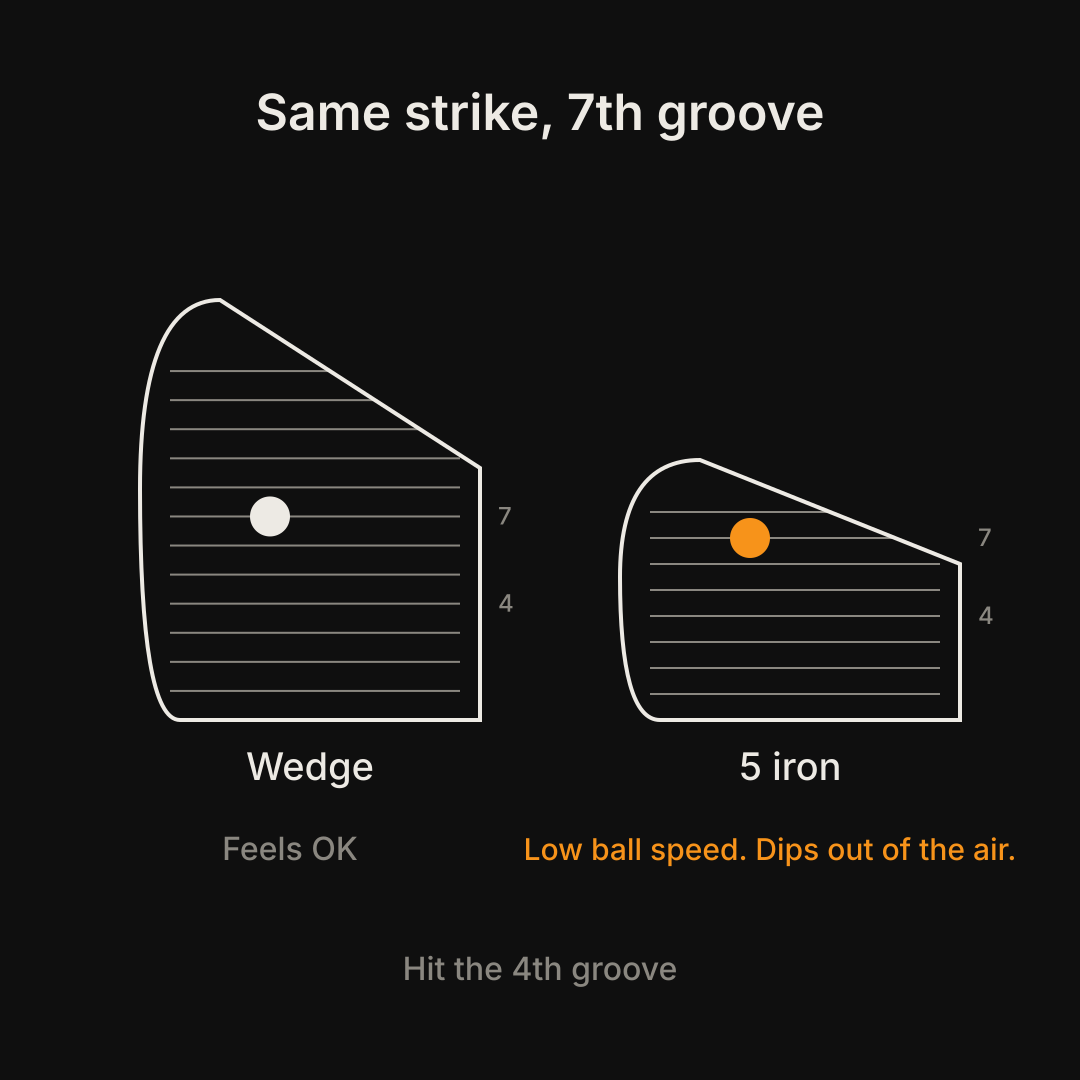
If you've ever noticed that your longer irons seem to go the same distance as your shorter irons, this is why. For example, your 7 iron goes further and you strike it better than your 5 iron. That's because the face is deeper on shorter irons. I don't remember where I heard it, but I have it in my head that I learned it from Ben Hogan: hit your irons in the 4th groove. So I was trying to get the 4th groove to strike the centre of the ball. If you hit groove 3 or 5 it will still be a good shot, but if, say, you hit a wedge out of the 7th groove, which is a bit high, it will probably feel OK and not affect the flight too much. Problem is, do that with a 5 iron and it will feel horrendous, low ball speed due to a lack of energy transference from the clubhead to the ball, and dip out of the air. That's the problem I discovered I had with my longer irons on par 3s.
What the turf and the face showed
The why turned up years later, in the winter of 2024/25.
It started on the course. My divots on iron shots were deep. Deeper than they should have been.
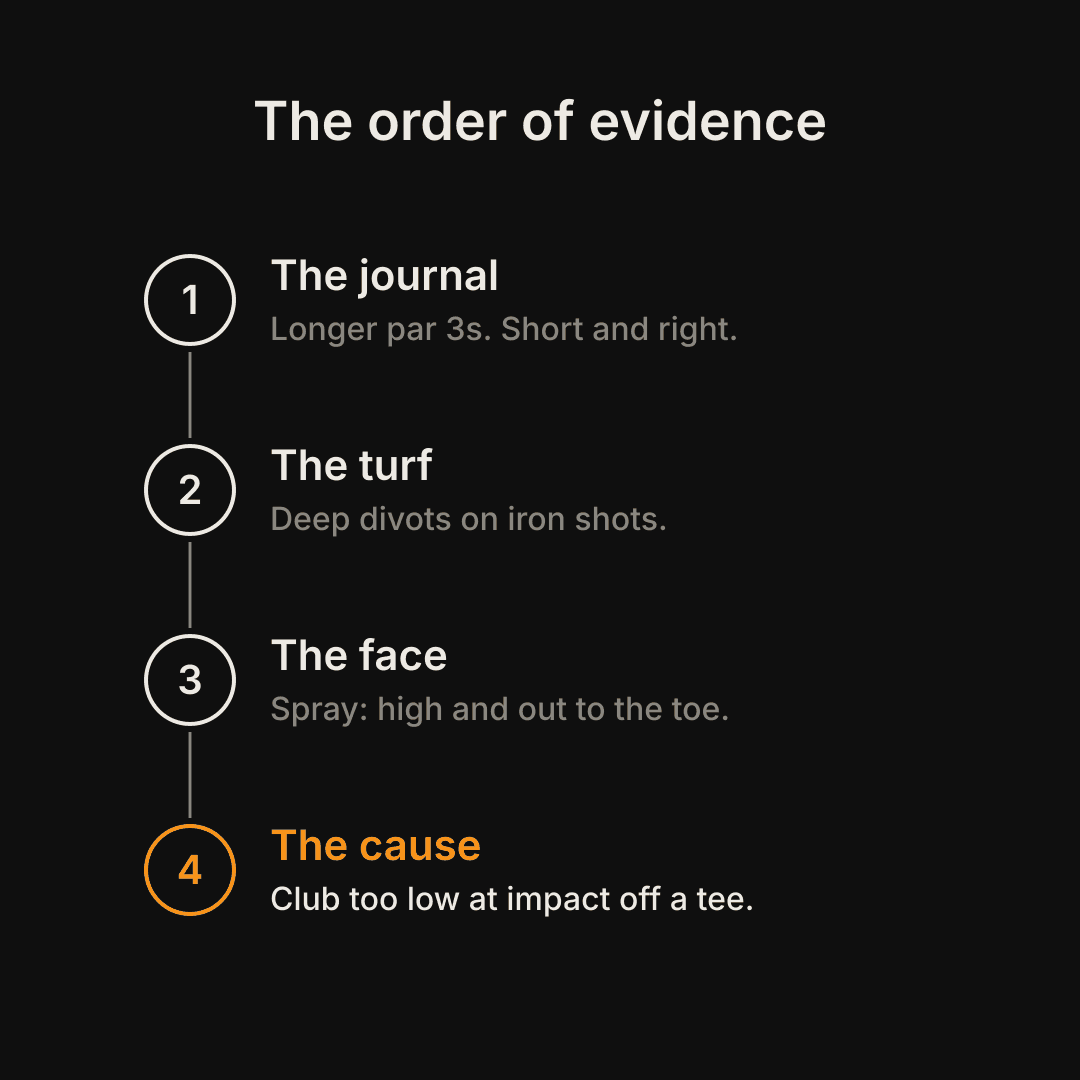
So I took it to the range and sprayed the face of the club before I hit. The spray shows exactly where the ball meets the face. Mine were high on the face and out towards the toe.
Then it made sense. Almost every ball I hit in practice was off a mat, and hardly any were off a tee. Off a mat, the strike looked fine. On a par 3, with the ball sitting up on a tee, my club was too low to the ground at impact with the ball, catching it high on the face and out of the toe, and the ball was coming up short. Combine the high-toe strike with a weak, open clubface and you've got the perfect recipe for a clunky, weak, short-right miss. Into the wind there was nowhere to hide.
This gave me the awareness I needed to make the change.
The change
The change was mine, for my strike. I sprayed the face on the range and practised hitting the ball on the 4th groove, off different tee heights.
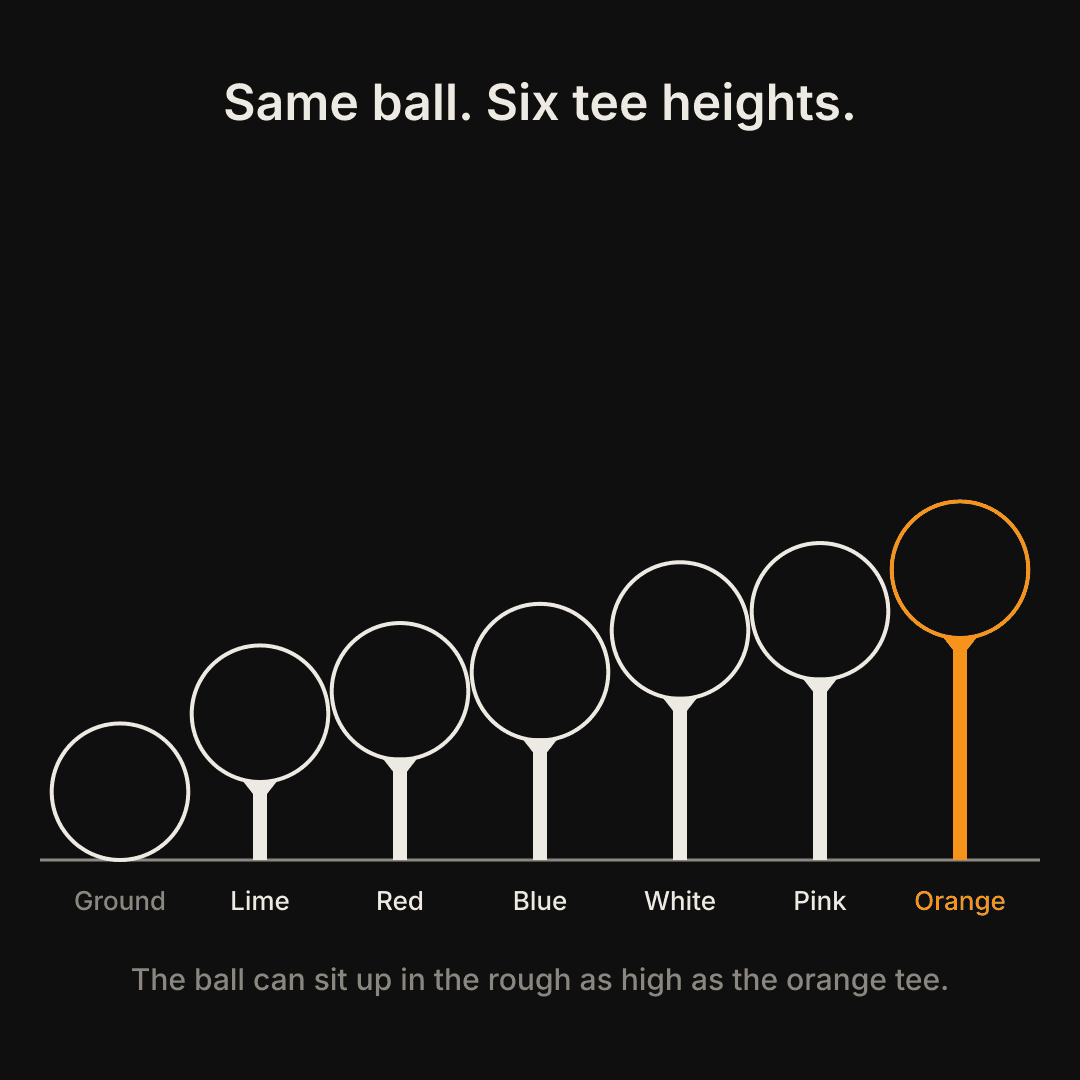
Different heights on purpose. There's no such thing as the perfect swing. The only consistent thing in golf is variability. So I practised for a range of tee heights, and let the spray tell me where each one met the face.
What people don't realise is that, depending on grass height, the ball is often sitting up in the rough at a tee height as high as the orange tee. I teach my students to become more adaptable golfers by hitting wedges off different tee heights, because this simulates the ball either sitting up in the rough or above your feet.
That was my miss and my cause. Yours could be a different miss with a different cause, which is why the next part matters more than the change I made.
What the numbers showed
By the time I made the change, I was tracking my rounds with Arccos. It measures every shot and compares you against a baseline using strokes gained, the method developed by Mark Broadie. I compare mine against a scratch golfer.
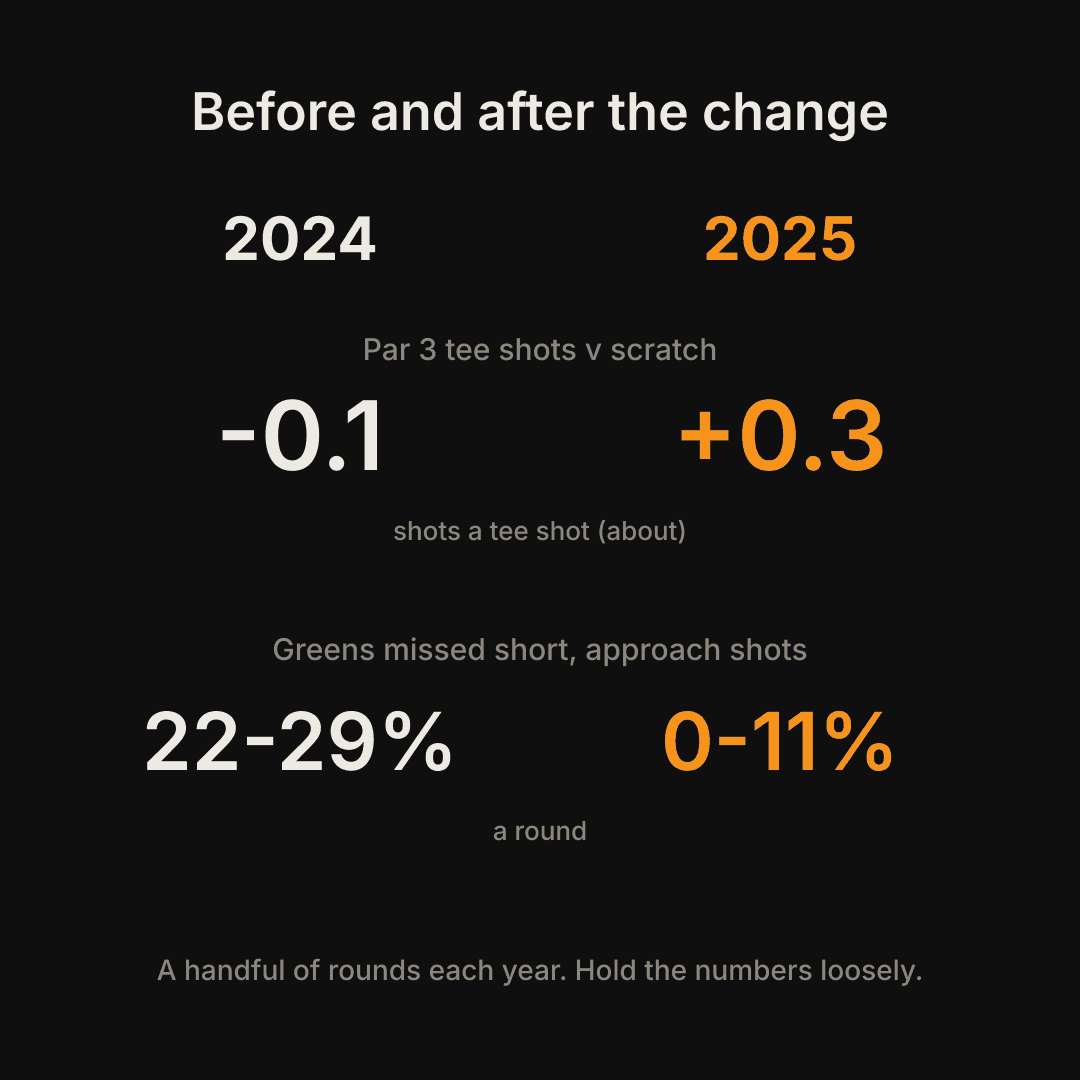
On full-size courses in 2024, I lost about a tenth of a shot against scratch on every par 3 tee shot. In my four full rounds that year, I missed between 22% and 29% of greens short on my approach shots.
In 2025, after the change, I gained about a third of a shot on every par 3 tee shot. Greens missed short on approach shots dropped to between none and 11% a round.
It's a small sample, a handful of rounds each year, so I hold the numbers loosely. But they point the same way as the divots and the spray. Three different pieces of evidence, all saying the same thing.
Your version
You don't need a shot-tracking app or Arccos to do this. I didn't have anything like it for most of the years I played as a junior.
After each round, replay every shot you hit in your head and make a tally of the shots you feel cost you, or the shots you feel you left out there. Where did the ball finish? Which club was in your hand? What was the wind doing?
On average, I consistently left around 10 shots out there per round. It's important you do this in the context of the standard you set for yourself, so I'd always compare myself to a scratch golfer. Say you shot 80. You could look back and say 10 shots cost you today. You could have shot 10 shots better, a 70, if you hadn't made those unforced errors (like in tennis). Most of the shots I lost were unforced, and some were just bad luck: 80/20.
Don't beat yourself up over any one round. You're looking for patterns that show up consistently over a long period of time. I suggest logging at least 5 to 10 rounds before jumping to any conclusions.
Then look for the miss that keeps coming back. One bad shot tells you very little. The same miss, on the same kind of hole, round after round, is a pattern. That's where you're losing shots.
Once you've found it, find out why before you change anything. Look at your divots. Look at where the ball meets the face. Take what you've found to your coach. A good coach will be able to help you identify the one thing to focus on, so you're not guessing. In my example, it was low point height and impact location on the face, two of the five Trackman Imperatives I learned from training with Scott Cowx. Your record points at the problem. Your strike explains it.
In my last post I wrote about the report you bring back after a round: where it broke, and what the ball did. One report tells your coach where a change broke. A season of them tells you where your game keeps breaking.
Before your next range session
Answer one question: where do your misses keep going?
Leave a comment and tell me the miss that keeps coming back. I read every comment.
The Sunday List is one idea a week, never a tip. Join here.
If you're in Edinburgh, book an Assessment.