Does this sound familiar?
It's three weeks since your last lesson. You're back in the bay, hitting a few balls to warm up, and your coach asks how it's been.
"Not great."
What happened?
"Don't really know. It just went."
You mean it. Somewhere between the last lesson and today, the change stopped working, and you didn't see where. You were on your own when it happened.
So your coach does the only thing they can. They watch you hit balls and start looking again. By the time you're roughly back where you finished last time, a big part of the hour has gone on finding something you already paid to find.
Neither of you knows where it broke. So the lesson starts from guessing again.
I have this conversation with golfers all the time. And it costs more than one hour. When every lesson starts from guessing, every lesson ends in roughly the same place. A few months of that and the conclusion writes itself: golf lessons don't work for me.
Your half
Two weeks ago I wrote about that conclusion in "Golf Lessons Don't Work for Me". That post was the coach's half of the problem: getting a change from the lesson tee to the first tee. In it I asked whether you want a change or an improvement.
This post is your half.
Your coach sees you for an hour. Everything that decides whether a change becomes an improvement happens in the weeks in between: on the range on your own, in the Saturday game, on the 1st tee with people watching. Your coach isn't there for any of it. You are.
After your lesson, write down what you learned. My clients do it in the CoachNow app, so I can see it and leave a comment if something doesn't look right.
There's a line I first heard from Neil Plimmer on a GOLFOTEC webinar during Covid. It's usually credited to Terry Doyle: "Whoever does the work does the learning."
In my experience, golfers who write down the top three things they learned after each lesson get better results. Memory research points the same way. In experiments by Jeffrey Karpicke and Henry Roediger, people who kept recalling what they'd learned remembered more than twice as much a week later. Writing down your top three is that kind of recall.
Then your job is to go and apply what you've learned in practice, and report back to your coach how it went and what you've learned between lessons.
What was the purpose of your round?
If you're playing a round after your lesson, decide the purpose before you go out. Are you going out to learn something, to explore the new setup or swing change? Or are you going out to perform: marking a scorecard, playing in a competition, or a match against a friend?
If you're exploring, be OK with a few bad shots. Don't beat yourself up or punish yourself, and don't worry about the outcome or the score. If you're exploring something new, like a swing feel, and it doesn't hold up on the course, and then you give up and start being hard on yourself, that's the last thing I want happening as your coach.
Then decide beforehand whether you'll park what you learned or persist with it.
Persist if you made the change in the lesson, then on your own on the range, and the score doesn't matter today. Then go and see if it holds up on a golf course.
Park it if you struggled in the lesson, haven't had time to practise on your own, or really care about the outcome. Park the technique stuff. Go and play golf, not golf swing.
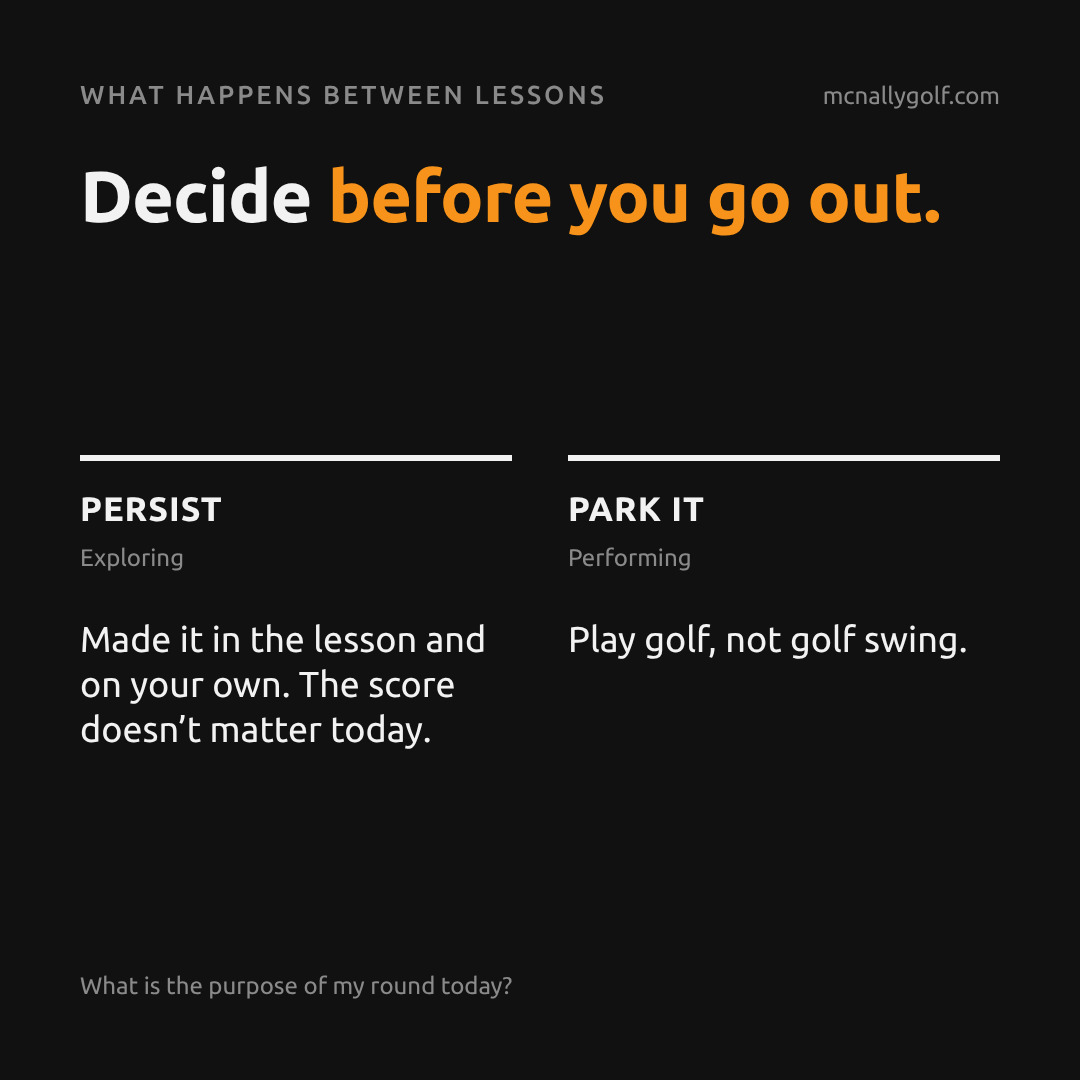
I learned to frame the purpose of a round from Peter Arnott, a coach I work alongside at Swanston. After a round, Peter would ask: did you frame the purpose of the round?
When a golfer tells me a change fell apart on the course, I ask what the round was for. Nine times out of ten, they were trying to perform when the round should have been for exploring. Nobody told them it was a choice.
Three buckets
I think of improvement in three buckets.
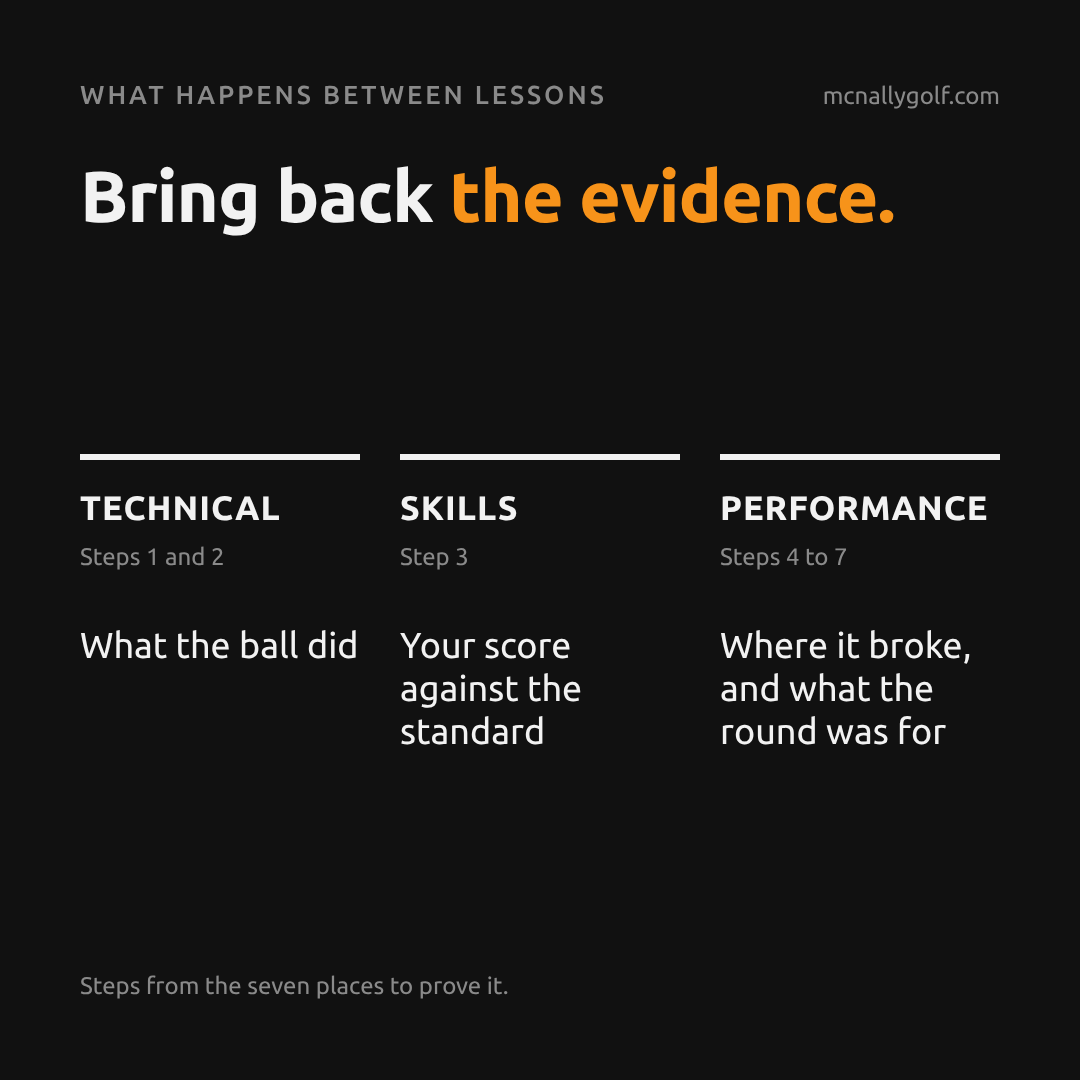
Technical. The change itself: a change to your setup, or to the motion in your swing.
Skills. Whether you can use the change in a game, with a target and a standard to hit.
Performance. Whether it holds up on the course, when the shot counts.
If you read that post, these sit on the seven places to prove it. Steps 1 and 2, in a lesson and on your own on the range, are technical. Step 3, the range game with a standard, is skills. Steps 4 to 7, from exploring on the course up to a competition, are performance.
What you bring back
Technical: what the ball did
When you made the change on your own, what did the ball do? Where did it start? Which way did it curve? Did it come out of the middle, the heel or the toe?
Tell your coach how it felt too. What you feel and what is real are often not the same thing. Just because a new change feels wrong to start with doesn't mean it's wrong. And equally, it could feel right, but in reality it's not what's actually happening. The ball is the evidence I work from in every lesson, and it's the evidence you can collect on your own.
"It felt good" gives your coach very little. "It started straight and drew a few yards" gives them a lot.
Skills: your score against the standard
On the range, you and your coach agreed a standard. Maybe six balls out of ten inside a target about as wide as a fairway.
Bring back the score. Four out of ten. Seven out of ten. Ten out of ten three sessions running.
The score tells your coach whether the change is ready to go to the course, or whether it needs more time where nothing is riding on it.
Performance: where it broke, and what the round was for
On the course, bring back three things.
Where it broke. Which hole, which shot, who was there. Was it the 1st tee? The first shot after a bad hole? The moment the match got close?
What you were thinking over the ball. The change, the score, your playing partners, the out of bounds down the left.
And what the round was for. Knowing that changes how your coach reads everything else you bring back. If a change breaks on the golf course, it could be due to external factors you can't control that you're trying to control, like your score or what other people think about you. A change that breaks while you're exploring is information, because if you're just exploring and not concerned with the outcome, your ball flight becomes feedback and your greatest teacher.
Note down what let you down. Was it strike or direction, or both? If it was strike, note down where you think it hit on the face, and if and where you hit the ground. If contact felt good and it was direction that was off, note down where the ball started relative to your target, which way it curved and where it finished.
Verdict or report
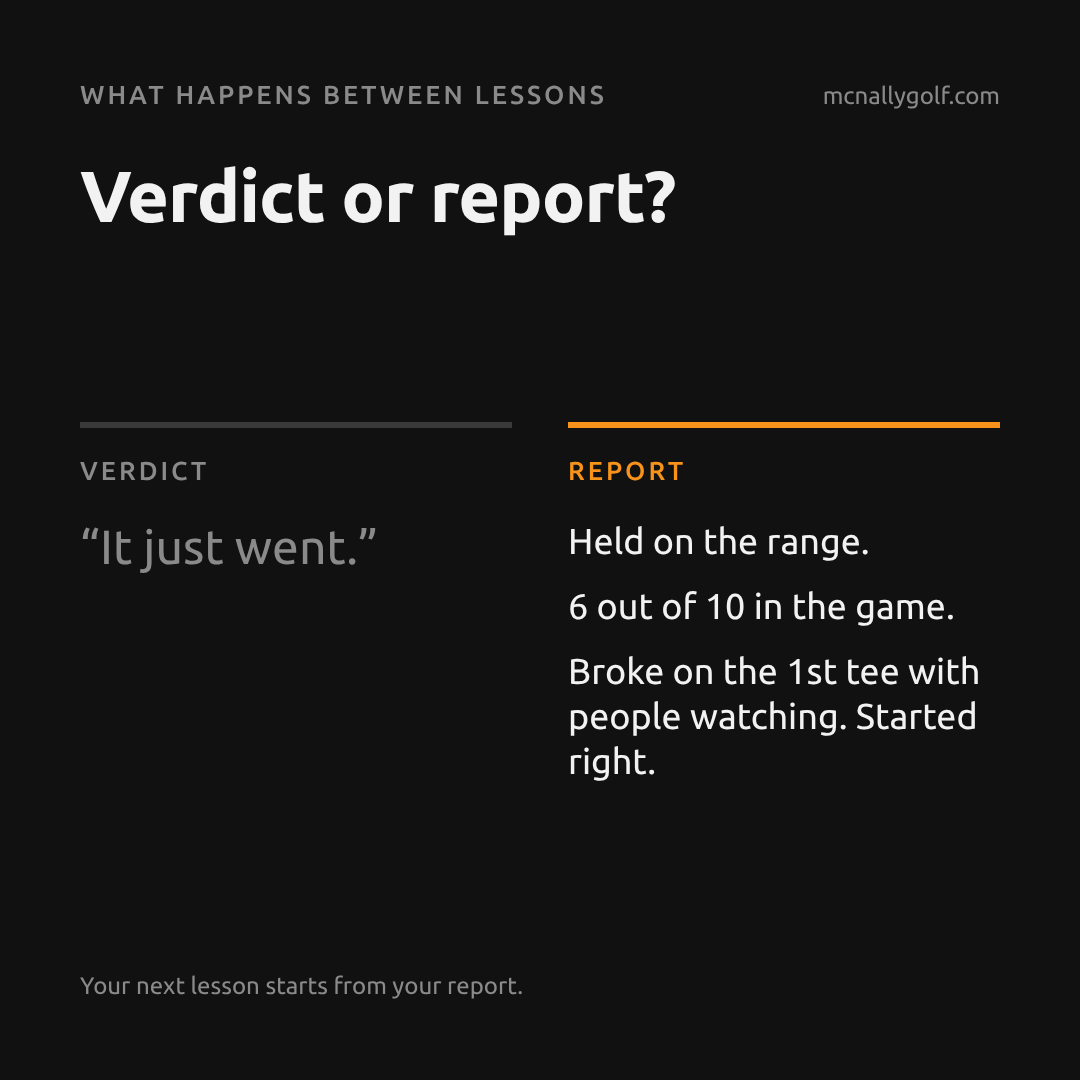
"It just went" is a verdict. It tells your coach how the last three weeks felt. It can't tell them where to look.
A report sounds like this:
Held on the range.
6 out of 10 in the game.
Broke on the 1st tee with people watching. Started right.
Three lines. Thirty seconds to say. And your coach now knows a great deal. The change held technically. It held as a skill. It broke under pressure, on one shot, with one ball flight. The lesson starts from that shot.
You can send it between lessons, as a message or a short video of the shot. Or you can bring it on the day. Most of my clients prefer to talk it through in person, and either works. What matters is that the report exists before the lesson starts.
Your next lesson
Your next lesson starts from your report.
Your coach reads it the way I read ball flight: as evidence. From there, they can work out what happened. Whether the change needs more time on the range. Whether the standard was right. Whether the round was ever set up to give it a chance.
That's a diagnosis. And the raw material for it comes from you.
So before your next round, answer one question: what is the purpose of my round today?
Leave a comment and tell me where your last change fell apart. I read every comment.
The Sunday List is one idea a week, never a tip. Join here.
If you're in Edinburgh, book an Assessment.