You've seen the post. A coach on Instagram, a slow-motion swing, and a line underneath: comment SWING and I'll analyse yours for free.
So you film one on the range and send it.
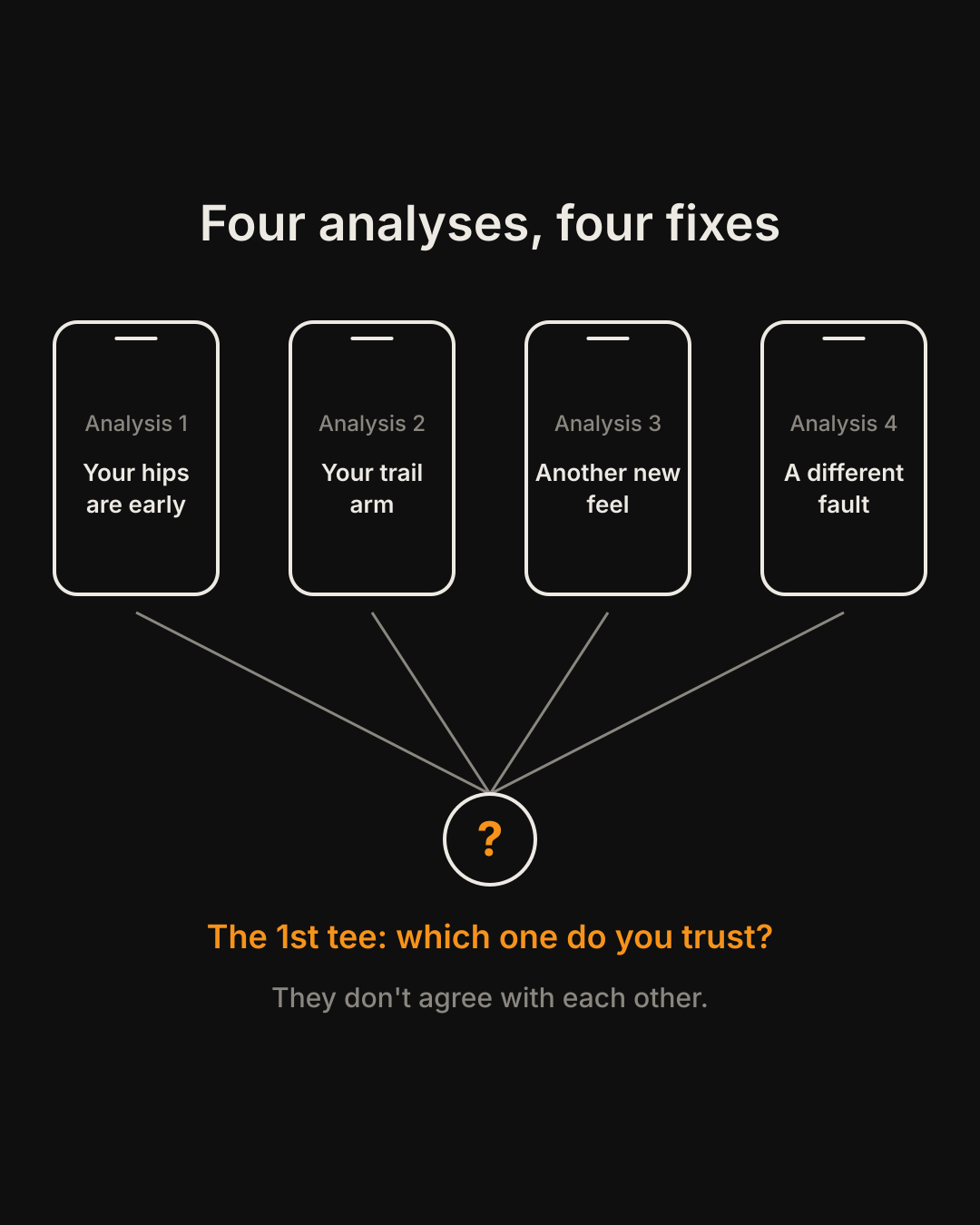
A day later your analysis comes back. Your hips are early. Try this feel. You take it to the range and hit three of the best shots you've hit all year.
By the weekend it's gone.
So you send the video to someone else. Different coach, different fault. Your trail arm this time. Another feel, another good session, another Saturday where it doesn't turn up.
Four analyses in, you've got four fixes. They don't agree with each other, and you're stood over the ball on the 1st tee trying to remember all of them.
Why three good shots feel like proof
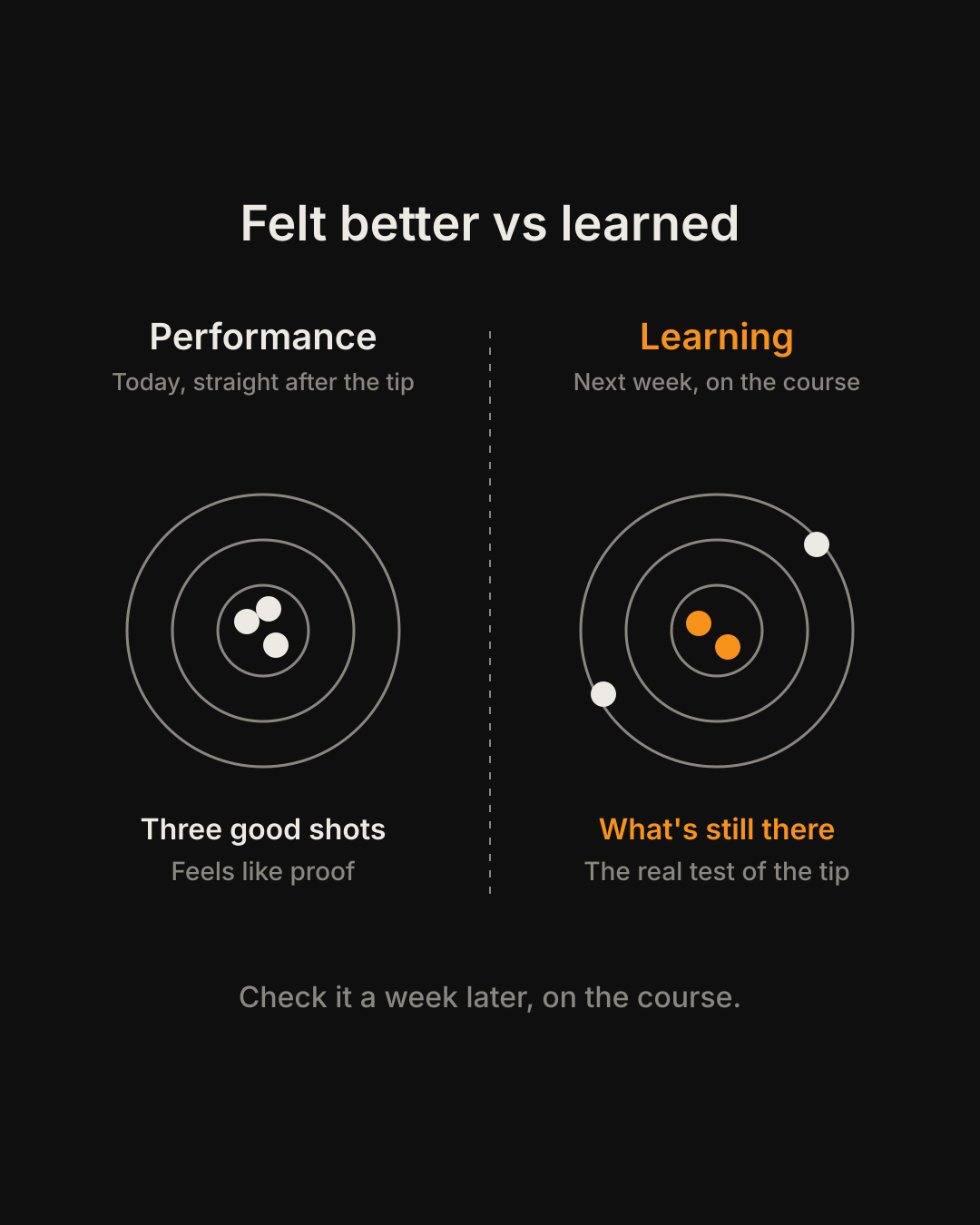
The shots you hit on the range were good, but they don't prove the tip worked.
There's a difference between hitting good shots today and learning something that lasts. Researchers who study how people learn movement call it performance and learning. Performance is how you hit it today, straight after the tip. Learning is what's still there next week, on the course, when it counts. Nicholas Soderstrom and Robert Bjork reviewed the research and called how people perform during a session "an unreliable index" of whether they've learned anything.
The trap is that it feels like learning. In a lab experiment by Linda Simon and Robert Bjork, using a simple movement task rather than golf, the group who practised one thing over and over made the fewest errors during practice, then did worse the next day. They had predicted they'd do better. The researchers described them as overconfident "to a striking degree".
Three good shots and the analysis feels like a success. Whether the change lasts is another question, and a one-off analysis rarely answers it.
What a phone clip can't show
Your phone shows one angle of one swing. Your phone, and often the coach, doesn't know your history, your body, or what you're working towards. Video is a good tool. But if your coach can't see your ball flight, or you can't tell your coach exactly what the ball is doing, it's not going to be a very accurate analysis. Most golfers I work with are unable to tell me exactly where the ball started relative to their target. That's because most people struggle to see straight when standing over the ball and in posture.
Dennis Clark is a PGA Master Professional in the US who coaches online himself. He says that without knowing a tour player's ball flight he might suggest changes that would hurt their game. He asks for a description of what the ball did with every video he's sent. That's a coach taking remote analysis seriously, and it's a step that's easy to skip in a one-off analysis.
Then there's the 1st tee. Rich Masters, who has spent his career studying why skilled performers fall apart under pressure, found that skills can break down when people try to control the movement by thinking through its mechanics. Four coaches can leave you with four different swing thoughts. The last thing you need on the 1st tee is to be working out which one to trust.
Why I stopped offering it
I used to offer free swing analyses on an online coaching marketplace where golfers can browse hundreds of coaches and sort them by price and rating. Offering free swing analysis was what the platform was recommending new coaches should do to attract new clients. But when everyone is offering the same thing, how do you stand out? Well, the only real way is to be the best and let the market decide.
Some people were trying to game the system by getting free advice from as many coaches as possible, hoping to find something that works. Others were trying multiple coaches because the last one didn't work. So I stopped.
There's nothing wrong with free swing analysis in general. I used to give away free in-person assessments when I was starting out as a young coach.
I don't blame the coaches who still do it. Most of us are self-employed in a crowded market, and a free offer gets you noticed. Plenty of good coaches use one, and some do it carefully.
My issue is with the system. On a marketplace, dozens of similar coaches sit side by side, and free is an easy way to stand out. When four coaches give you four different fixes, most of them are guessing. That’s on the coaching industry as a whole. You’re not to blame, and neither are the coaches working in it.
Free analyses are each coach’s choice, and the platforms argue they bring coaches more students. In my view, though, they have made a free diagnosis from a stranger the easy first step into coaching. That’s bad for golfers and bad for coaching.
I would also argue that this should not be the first entry point for a new student. My initial assessment with a new player is where I take my time and go as slow as possible. I give them as little information as possible, just what they need to hear. I talk as little as possible, apart from asking all sorts of open-ended questions. I want to really get to understand as much as possible about the player before I offer any advice. The assessment is the single most important part of my 4-step coaching process.
So overall, have these marketplaces been good for the industry? Yes, but at what cost?
What to look for instead
Free information is everywhere. A lot of it is good. Some of it is also terrible. There also seems to be an obsession with meaningless phrases like "shallow the club", and an obsession with club path. Use it to find a coach whose thinking makes sense to you.
The value is in having a coach apply those ideas to your game and check whether they're working.
So before you send your swing to the next coach, ask four questions.
Will they see you again? A change takes time to bed in, and it can break where you don't expect it. You need someone who'll be there when it does.
Do they ask what the ball did? If the first question is about a position in your swing, and nobody has asked about your ball flight, they're guessing. And if your coach is guessing, you’re guessing too. That’s not your fault.
Do they want to know what you're after? A change is not always an improvement. New clients often report that their last coach never actually asked them what they wanted and what their preferences were. That leads me to believe that coaches are not listening to their students properly, and are not asking the right questions to find out what the student actually wants. Students need to be heard.
Will they check whether it held? A better test of a lesson is what's still there a month later, on the course. If nobody's checking, nobody knows.
One coach. One plan. Long enough to find out whether it's working.
Your next swing video
If you've got four fixes saved on your phone from four coaches, pick the one whose thinking makes most sense to you and go and see them. Tell them about the other three. Then let them start from what your ball is doing.
Tell your coach about everything you've got going on in your head. I, for example, want to know if you have a guessing, learning or movement error. A learning error is when the thing you are trying to do is incorrect, therefore it's never going to work. A movement error is when the thing you are trying to do is correct, but for a number of reasons you physically can't do it. And a guessing error is the worst of them all. You're working on the wrong thing and you can't even do it, so even if you could do it, it wouldn't work. If you don't tell your coach that you're trying to do some move in your golf swing, then they won't be able to help you unless they can ask you the right questions.
Leave a comment and tell me the best, or worst, free advice you've been given. I read every comment.
The Sunday Lesson is one big, simple lesson a week, never a tip. Join here.
Want a coach to look at your game properly? Book an online Assessment: mcnallygolf.com/online-golf-assessment